Tuesday, March 17, 2026

Excursion Sicuani 2026

 Adventures around Sicuani! 

We are hosting a wonderful family: mother, father, 15-year old girl, and 14-year old boy. None of them have ever stayed in a hotel before, nor soaked in a hot springs.

(Note: cell phone blogging is challenging, and many of these pictures are duplicated and out of order. Have fun with it!)


Plaza central in Sicuani

Purging waters of San Pedro
The grounds are beautiful and the toilets clean. 
One drinks at least a dozen cups the this water. Poops until the poop is clear, and then done. Recommended is a glass of aloe vera juice followed by a broth-rich soup. 

Incan Spirits: Puma, land; Condor, air; Serpent,
Fountain of purging waters of San Pedro
Chemical analysis of purging waters (sort of like a colonoscopy prep)

Aguas Calientes, up in altitude from Sicuani

Mineral-rich hot water soothes the muscles; gives fun for play. The kids got a bit of swimming lessons  lake Titicaca is a bit too cold for serious swimming.


(These pictures are not in chronological order; too difficult to rearrange on my phone )

The Bonbonera Market in Sicuani

This is a HUGE market, covering several blocks on the street as well as covered areas.  Alicia especially wanted to buy som special seed corn and fava beans. They also found a good deal on bayeta, the natural wool fabric used to make traditional shirts on Taquile.

Mercado Bombonera 

Near our hotel is the Central Market, where we ate breakfast every morning and bought our treats a picnic supplies. 
Mercado Central, where we ate breakfasts

Raqchi, major Incan archaeological site

We hired a local Guide, and our good fortune was it was the same guide we had hired in the past, Denis. He is very experienced and told us good stories. Took our picture as a group. We had visited his father, who is a very competent potter, in previous years. (Note: More Raqchi continued after Tinta)

Entrance to Raqchi 


From the Mirador at Raqchi 

Tinta and the Tupac Amaru museum
The museum is a difficult and terrible part of Peruvian history when the Spanish conquerors inflicted torture and slavery on the indigenous people, and in particular their leader, Tupac Amaru , and his family. The museum consists of paintings telling the story and shows lots of blood and suffering. Afterward, to cheer ourselves up, we have ice cream and chicha in the main square.

Chicha and ice cream at Tinta

Sacos y sacos de maíz, Tinta

Tupac Amaru museum in Tinta

A small structure tucked in Raqchi

View of Raqchi from The Mirador

The Inca baths fountain (do not drink!)

The biggest wall at Raqchi 

The December Solstice hallway


The bus ride from Puno to Sicuani was 6 hours and over a 14,240ft (4340m) pass

Inside the food storage qolqas at Raqchi 

Thursday, February 26, 2026

40 years, 23rd visit

 2026, 40th anniversary 

Our first visit to Taquile Island, as tourists, was in 1986. On that trip too big things happened: 1)We caught the dream of bringing a Taquileño couple to the United States. 2)We observed that Taquileños had no dependable source of electricity on the island.  

The results were that we brought that couple to the United States in 1988. It was magical, full of serendipitous meetings and fun (You can read about it on the earliest posts of this blog). And that led to us becoming godparents and coparents, and even parents and grandparents, with deep relationships in this beautiful community.

The other result was that we returned in 1988 with the first solar electric panel, thereby introducing solar to the island. Now many houses have rooftop solar and the entire island has large community array, feeding inverted power to all the houses. You will see many of these stories throughout this blog.

Traditional “pollo broaster” dinner

So this week we are back for the 23rd time, having visited mostly every other year or every year with a few gaps. We don’t think of this as tourism at all, but our other life with our beautiful indigenous family of Taquile Island.

First, we stay in Puno, the “folkloric capital of Peru” the big city by the bay where we will catch a boat to the island in the morning. Here are a few pictures from Puno:


Saturday, April 26, 2025

Easter 2025

Singing in the Churches 

A few weeks before Easter, groups of singers gather to make up new songs and practice for the nights and a day of singing in the churches. Taquile is organized into six suyos, or sectors or neighborhoods. Each has its own chorus and musicians. They each created at least a dozen new songs.

Giant pots of soup feed the singers before practices and performances. 
Most of the women sit on mats snd blankets on the floor.


The authorities keep everyone awake with coca leaves. Thursday, Friday and Saturday nights, they sing until 1:00am

Easter Day

After Easter mass in the big church in the plaza, the authorities leave the singers and lead a procession to two ceremonial sites. We joined the one to the mountaintop, Mulcina. 


Life and Death

 On Taquile Island, the custom when someone dies is to refrain from productive work until the body is buried. So that means no weaving knitting; no work in the fields. It’s OK to play volleyball and of course to cook food since we all have to eat.  

A complete life 

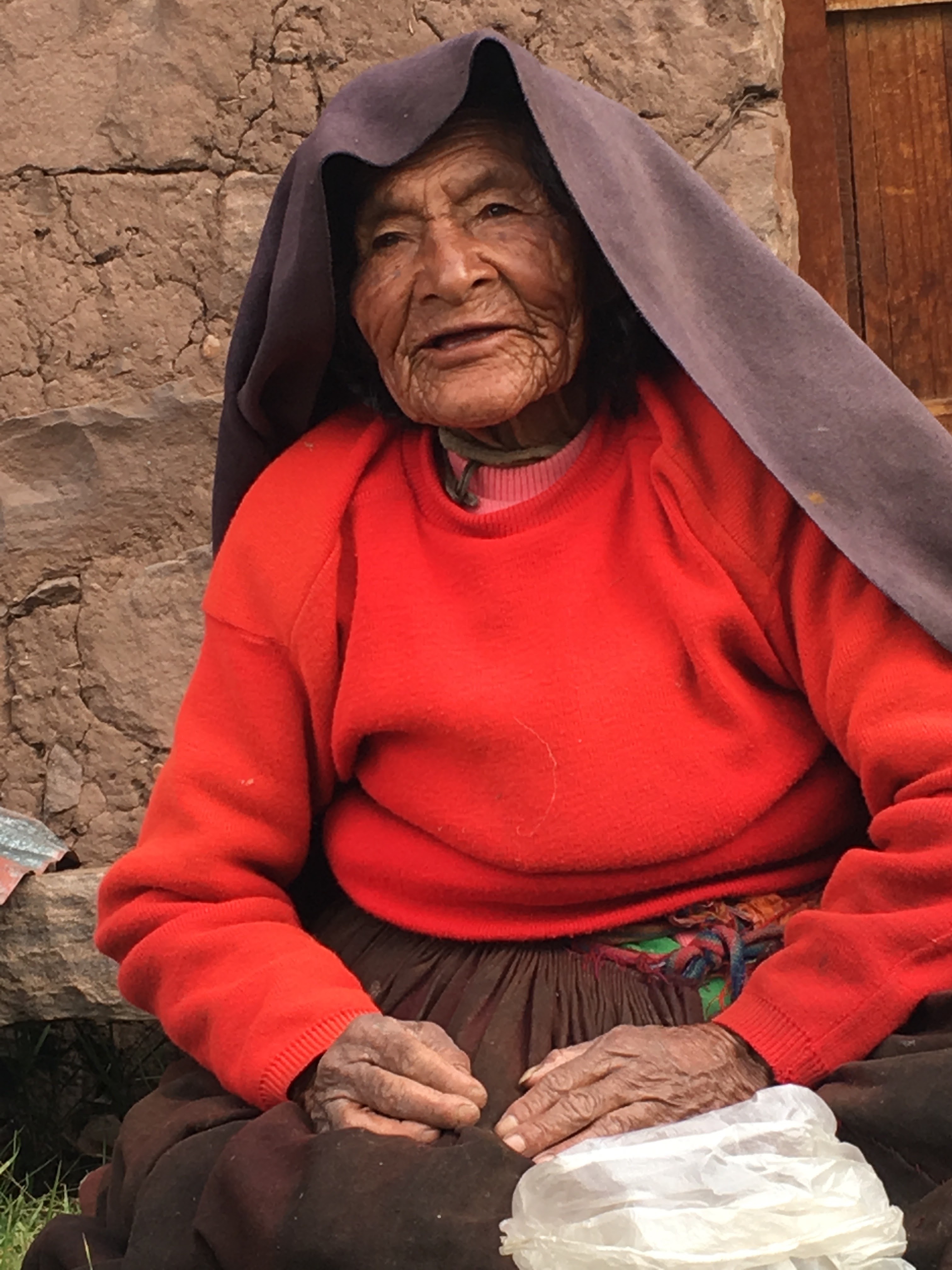
The Matriarch of our family Mercedes Cruz Huatta died in the wee hours of Friday, April 11. Her age is estimated at 109 years. She is survived by one daughter, 5 sons, and numerous grand- and great-grandchildren. Two daughters died before her. She didn’t have a birth certificate, so her age is estimated based on that of a girlfriend who did have a birth certificate. She was able to participate in household activities until about a month before her death, when she spent much of her time in bed. 


Picture from 2019

Years ago, we participated in a burial and the body was sewn up in fabric. However, Mercedes was honored with a wooden casket.  Silvano had gone to the house in the predawn hours, and we came later. I sat with the widower, Sebastian, who shared how “triste” he was feeling. I showed him pictures of his wife on my camera from 2019. They had been married for 30 years. After eating soup, the top of the casket was opened to view her face. Coca k’intus were made and shared. 


Then the procession


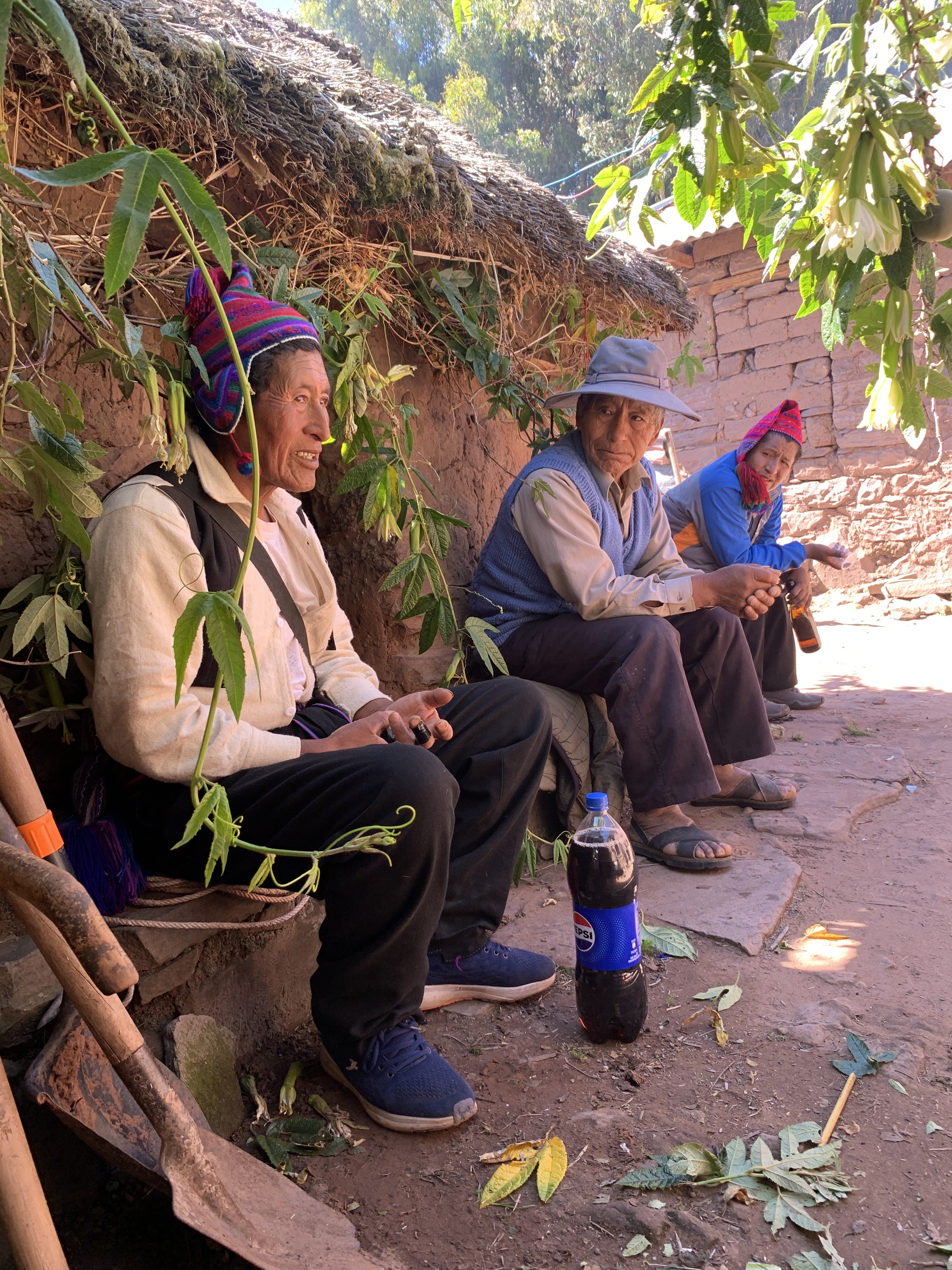
The casket was carried to the burial site in a procession of about 40 people who witnessed and men dug the grave. The soil was clay and sand with, luckily and surprisingly, no rocks.  We all shared coca and beer or sodas over the two and a half hours of digging. 


They carefully measured the casket and at the moment of lowering it into the grave, a chorus of women broke out in harmonic songs.  


We cover the casket in flowers before mounding up the dirt and sod. It was a rich and moving ceremony, followed by a procession in the dark, by a different route, to the house and a cleansing smoky smudge. Close family stayed late and Sam and I returned home. 


The next day we/they wash everything. 

Clothes worn to the burial, blankets from the sick room, more. We did our own here at the house, whereas others (close family) worked nearer the grieving household at the lakeshore. I’m told they will take a different route from the lake back home.


My understanding is that the spirits of the dead need to be acknowledged, redirected and maybe even confused. Hence, not walking back through the same path, so any lingering spirit can’t latch back on. And all the washing, the cleansing. 


Church service and family day


The following Wednesday was to be the church funeral service and mass for our beloved Mercedes. We cooked and served sheep meat, both as soup and as barbecue for the participants. Sebastián offered two of his remaining 3 sheep to be served up in a family feast. 


Tuesday I helped butcher two sheep by holding the legs, or fetching basins, while Silvano and Alipio did the hard work. We gave the sheep our gratitude, and they were killed and bled quickly.


On Wednesday, we got up at dawn to walk to Huyllano for the service. Saturn, Venus , and Mercury were still visible in the eastern sky (though you might barely see a pinpoint of light in this photo).


It was a mass in the Catholic Church.

 Then back to the house for a breakfast soup, lots of coca, offerings, and stories. 

One of my favorite stories about Mercedes was when we traded a very small solar electric system with her, her first light besides candles. She was about 80 years old. It was when white LED’s had just been invented. The system was a 10w panel, a little solid-state battery and three small LED lights. When we visited her a week later, she clapped her hands together and said, ”I feel so young now that I have lights!“ That panel and the lights are still functioning; the battery has been replaced.

See the little panel on the thatched roof?


Patcha Manca

The cooking event was a Patcha Manca, earth oven, wherein flat rocks are built into an arched structure, heated for several hours by burning eucalyptus branches, and small logs. 


When the rocks are hot enough, the arch is disassembled and reassembled with food. Foil has become the wrap of choice for the marinated meat, keeping the juices intact and everything clean. Meat first, then potatoes and oca (sometimes fava beans). Once all the layers are built up, a generous pile of muña (a perennial bush in the mint family) covers the rocks, then tarps , then soil, insulating the whole pile for another 1/2 hour. Waiting. Then the disassembly, serve and eat. 
Delicious !

The extended family spent the entire day together.


We told stories, shared coca and food and drink. Samuel and I felt very honored to be so deeply included in this moving and important time in the life of our extended family.