--Part 1, Albuquerque
IAF Conference in Albuquerque, November 16 - 20, 2010
 The 5 groups hosted by the Inter American Foundation--from Peru, Panama, Mexico and Bolivia--toured museums and native cultural centers in Albuquerque and Santa Fe.
 Here Juan and Luz speak on the Taquile solution.
The conference featured panels on such subjects as how to enhance income from tourism while maintaining the community's cultural integrity.

The final evening featured a whirling dances from our Taquileño group. Loey Cohen Kirk hosted a dinner in her home for all the Taquileños. A delightful evening of food, music and dance.
 Loey Cohen Kirk hosted a dinner in her home for all the Taquileños. A delightful evening of food, music and dance.
The Taquileños brought 100 SuperBright (and super efficient) LED light strips back home to Taquile Island. They use small solar panels to supply power, so efficiency is important.
See earlier blogs (April, 2010 Solar Panel Trade, and Feb 2010, Background) for more stories about solar electricity on Taquile.
See earlier blogs (April, 2010 Solar Panel Trade, and Feb 2010, Background) for more stories about solar electricity on Taquile.
Taquileño Whirlwind Tour--Part 2, Arvada and Aspen
After the conference in Albuquerque, Sam and Tara brought three of the Taquileños, Silvano Huatta Yucra, Juan Quispe Huatta, and Luz Medy Flores Machaca for a grand adventure in Colorado.
Our first stop was Boulder for a traditional Thanksgiving with Tara's sister, Judy Hill Lovins and her son and his wife, Miles Hill and Nastassia Urlapava-Hill. Before dinner we attended a beautiful Thanksgiving service at Unity Church in Boulder.
 Sam, Silvano, Juan and Luz at Unity Church
Sam and I were scheduled to sell our pottery in Arvada, Colorado at the Holiday Craft Fair at the beautiful Arvada Center over Thanksgiving Weekend, so we happily were able to secure a space for the three Taquile visitors. The fair director's daughter-in law, Olga Pense, helped sell and translate. She was a great help and we all fell in love with each other.
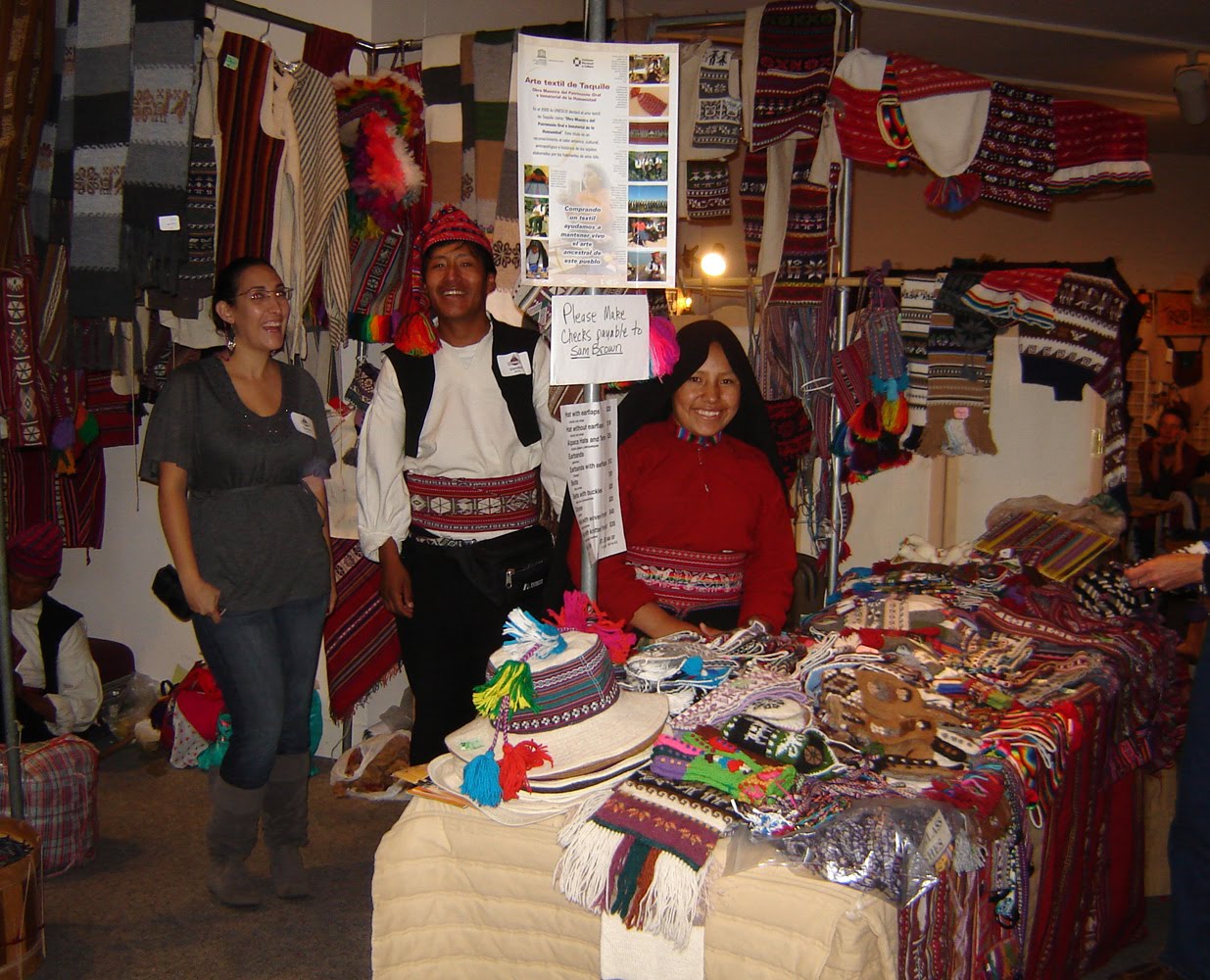 Pictured are Olga Pense, Silvano Huatta and Luz Medy Flores in their booth at Arvada.
Luz demonstrated her detailed weaving techniques with a display of wrist ties nearby.
 Here Silvano is helping Luz to find thread colors as Juan looks on.
 Luz, Silvano and Juan prepare to dance through the fair in traditional Sicuris costumes.
Next stop, Aspen, hosted by Judy Hill and Amory Lovins.
We enjoyed dinner and a tour of the Rocky Mountain Institute, "The Banana Farm." Learn more at http://www.rmi.org
 Pictured are Silvano Huatta, Amory Lovins, Sam Brown, Judy Hill, Juan Quispe and Luz Medy Flores
Thanks to The Aspen Skiing Company which gave us complimentary tickets to ride to the top of Aspen Mountain. Silvano had spent his life looking at the snow-capped peaks across Lake Titicaca, dreaming of someday being IN the middle of the snow. This was a dream come true.
 Juan, Luz and Silvano, preparing to ride the gondola
 Judy and Silvano in the Gondola, with the town of Aspen below
 Luz Medy Flores, on top of the world!
 Silvano Huatta Yucra , celebrating his dream of being in the middle of snowy mountains!
On November 29, we gave a public presentation at the Aspen Center for Environmental Studies which included a slide show, dancing, textile demonstration and a talk from Juan about the Andean World View and how it relates an experience of nature as expressed in the complex symbols within the textiles of Taquile Culture. The presentation was repeated in Paonia the following week.
Taquileño Whirlwind Tour--Part 3, Paonia
Finally we arrived at our own home in Paonia. Many of our local friends got a chance to meet our Peruvian friends after hearing about them all of these years. We were interviewed on our local community radio station, KVNF. You can listen to the interview on the KVNF archives at http://www.kvnf.org/music/talkin-music-nativos-de-tequile
 In the bamboo room recording the interview at KVNF
We entered the door of the Christmas party at the Schweiderman household dancing and playing the pan pipes.
 Pictured here at the party: Silvano, Katya, Leanne, Luz, Neil and Juan
Larry Garret of Aero Tow Unlimited gave each of us an airplane ride around Lamborn Mountain in his little two seater. What a thrill!!!
 Luz in the airplane. She loved it.
 Juan, Tara, Luz and Sam with textiles and pottery
 Luz and Sue
On Monday, December 6, We gave a presentation at the Blue Sage in Paonia. The show included textile demonstrations and sales, a slide show, a talk from Juan about the Andean World View as expressed in the symbols of the Taquile traditional textiles, music and dance.
 Luz twirls with Michael Soule
 Dancing on the Stage at the Blue Sage Center for the Arts
 Daniel translated for Juan
After our presentations we made an excursion to the Black Canyon of the Gunnison National Park, on the North side out of Montrose. That same day we did some shopping and soaked in Ouray Hot Springs.
 Silvano, Luz, Sam and Juan at the Black Canyon of the Gunnison
 Juan at the Black Canyon
Conclusion: A once-in-a-lifetime experience for all of us. Our relationships deepened, we were able to share our Peruvian friends with our New Mexico and Colorado friends.
Taquileño Whirlwind Tour--Part 3, Paonia
Finally we arrived at our own home in Paonia. Many of our local friends got a chance to meet our Peruvian friends after hearing about them all of these years. We were interviewed on our local community radio station, KVNF. You can listen to the interview on the KVNF archives at http://www.kvnf.org/music/talkin-music-nativos-de-tequile
 In the bamboo room recording the interview at KVNF
We entered the door of the Christmas party at the Schweiderman household dancing and playing the pan pipes.
 Pictured here at the party: Silvano, Katya, Leanne, Luz, Neil and Juan
Larry Garret of Aero Tow Unlimited gave each of us an airplane ride around Lamborn Mountain in his little two seater. What a thrill!!!
 Luz in the airplane. She loved it.
We sold both pottery and textiles at the Blue Sage Holiday Art Fair. With our two booths we took over the whole stage with a colorful display.
 Juan, Tara, Luz and Sam with textiles and pottery
Sue Pritchett came all the way from Lake Tahoe to be with our Taquile Family. She was a big help at the Craft Fair.
 Luz and Sue
 Luz twirls with Michael Soule
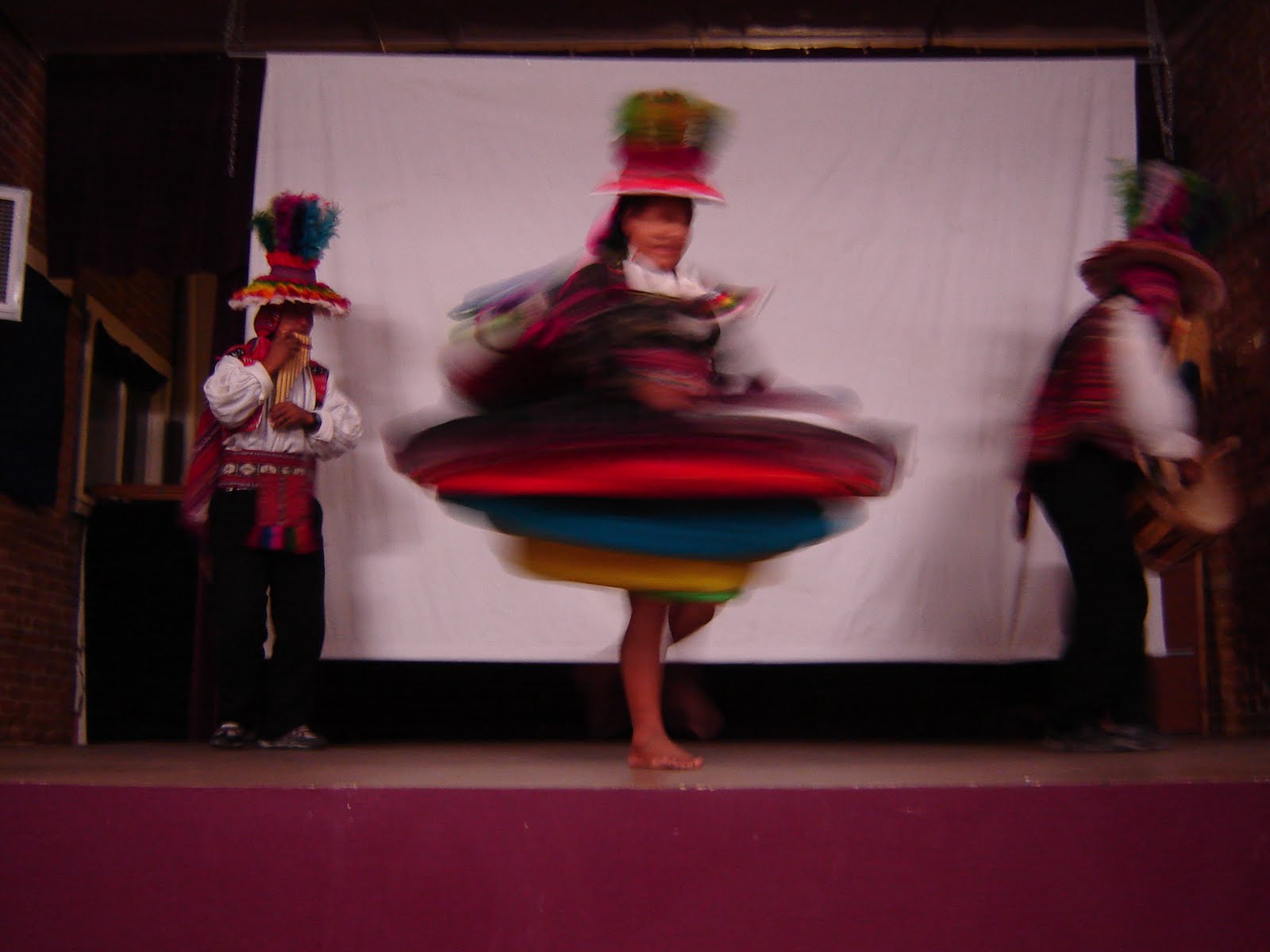 Dancing on the Stage at the Blue Sage Center for the Arts
 Daniel translated for Juan
After our presentations we made an excursion to the Black Canyon of the Gunnison National Park, on the North side out of Montrose. That same day we did some shopping and soaked in Ouray Hot Springs.
 Silvano, Luz, Sam and Juan at the Black Canyon of the Gunnison
 Juan at the Black Canyon
Conclusion: A once-in-a-lifetime experience for all of us. Our relationships deepened, we were able to share our Peruvian friends with our New Mexico and Colorado friends.


 Rosa will have a new LED efficent light in her new kitchen (the chimney is already installed above a beautiful wood cooking area with outside air intake!)


 Next you rake out most of the ashes and coals and throw in a handful of potatoes.
  Knock in the dirtclods at the top of the dome and break them up. The soil is very sandy, so easy to break.
 The kids made their own small watia and added fresh corn in the husk when it was ready.
 After an hour or so, come back and dig it all up. Some potatoes are a bit burned or crispy like potato chips, but mostly the food is perfectly cooked and wonderful. Brush off the sand (Hey! it's sterile!), wrap it in an uncuña (handwoven food-carrying cloth) and gather the family around. We dipped ours in avocado-onion-tomato, fresh piquante salsa, and the traditional salty green clay. Sometimes they make lakeweed (like seaweed) cooked in milk.
 We brought Cusi a gift, a set of artisan projects, from her godparents Luke and Ellen from Gunnison. In this picture she is concentrating on an arrangement of beads for a bracelet for herself. The candle making kit suggested using a hair dryer to warm and soften the pressed wax so it could be rolled around a wick, but we figured out that body heat would do the trick! We've had fun working together with the projects.
 Cusi's little sister, Sarita. On our 2006 trip Sam made a very special relationship with her just as she was learning to walk! Now they are fast friends.
 Sam has remade a magic relationship with sweet, shy Cecilia. I did something to make her laugh and slightly cover her face just as I snapped the picture. He admits that these little girls easily steal his heart.
  Laundry drying at the rough dock just below our house.
 My good friend, Nancy Schweiger, eats watermelon here with Eufrasia. Nancy and Sue Pritchett are godmothers to Ivan, Silvano and Ruperta's oldest son. This is their first visit since cutting his hair in the godparent ceremony 7 years ago.