Showing posts with label community. Show all posts

Saturday, April 26, 2025

Easter 2025

Singing in the Churches 

A few weeks before Easter, groups of singers gather to make up new songs and practice for the nights and a day of singing in the churches. Taquile is organized into six suyos, or sectors or neighborhoods. Each has its own chorus and musicians. They each created at least a dozen new songs.

Giant pots of soup feed the singers before practices and performances. 
Most of the women sit on mats snd blankets on the floor.


The authorities keep everyone awake with coca leaves. Thursday, Friday and Saturday nights, they sing until 1:00am

Easter Day

After Easter mass in the big church in the plaza, the authorities leave the singers and lead a procession to two ceremonial sites. We joined the one to the mountaintop, Mulcina. 


Life and Death

 On Taquile Island, the custom when someone dies is to refrain from productive work until the body is buried. So that means no weaving knitting; no work in the fields. It’s OK to play volleyball and of course to cook food since we all have to eat.  

A complete life 

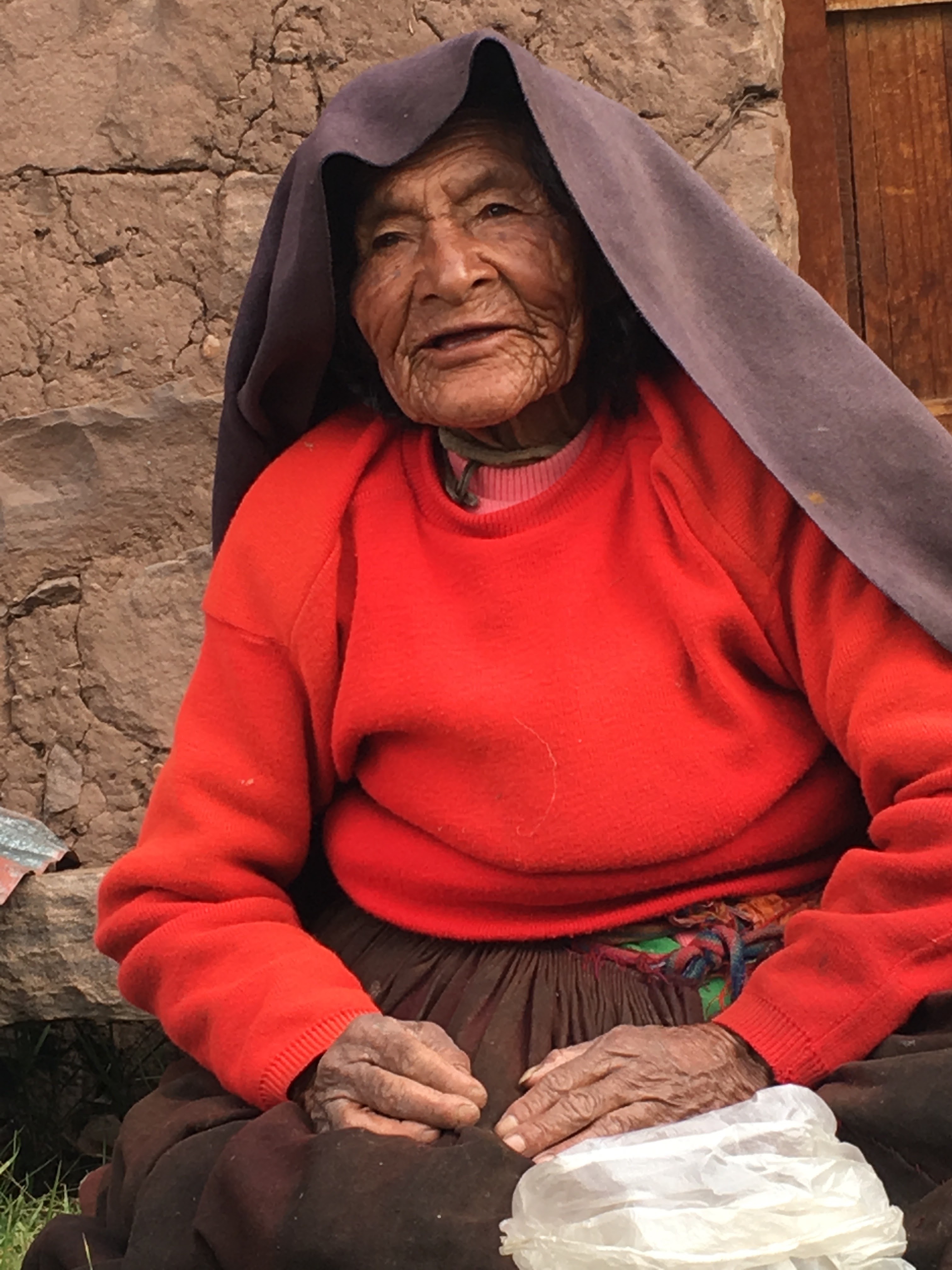
The Matriarch of our family Mercedes Cruz Huatta died in the wee hours of Friday, April 11. Her age is estimated at 109 years. She is survived by one daughter, 5 sons, and numerous grand- and great-grandchildren. Two daughters died before her. She didn’t have a birth certificate, so her age is estimated based on that of a girlfriend who did have a birth certificate. She was able to participate in household activities until about a month before her death, when she spent much of her time in bed. 


Picture from 2019

Years ago, we participated in a burial and the body was sewn up in fabric. However, Mercedes was honored with a wooden casket.  Silvano had gone to the house in the predawn hours, and we came later. I sat with the widower, Sebastian, who shared how “triste” he was feeling. I showed him pictures of his wife on my camera from 2019. They had been married for 30 years. After eating soup, the top of the casket was opened to view her face. Coca k’intus were made and shared. 


Then the procession


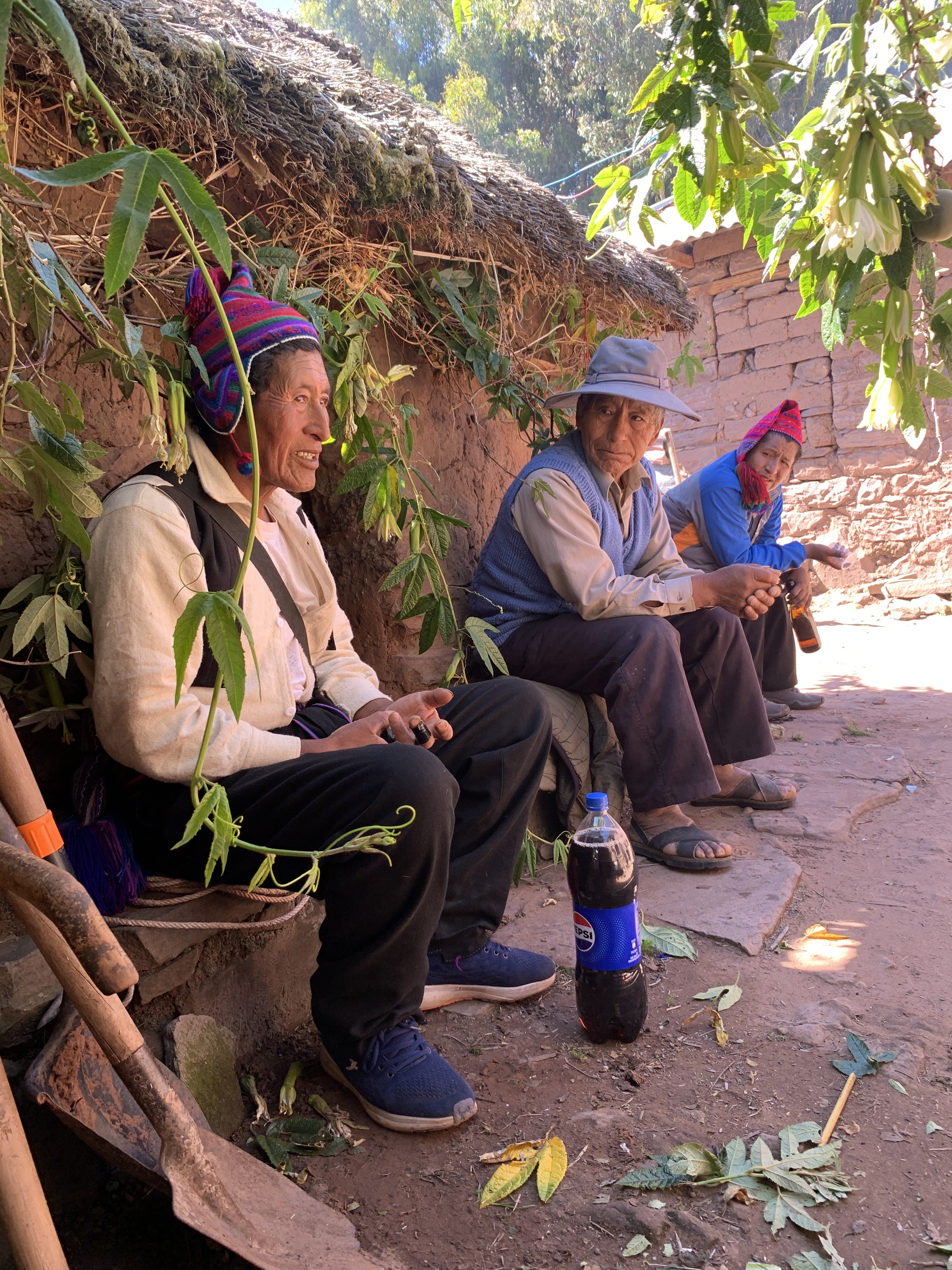
The casket was carried to the burial site in a procession of about 40 people who witnessed and men dug the grave. The soil was clay and sand with, luckily and surprisingly, no rocks.  We all shared coca and beer or sodas over the two and a half hours of digging. 


They carefully measured the casket and at the moment of lowering it into the grave, a chorus of women broke out in harmonic songs.  


We cover the casket in flowers before mounding up the dirt and sod. It was a rich and moving ceremony, followed by a procession in the dark, by a different route, to the house and a cleansing smoky smudge. Close family stayed late and Sam and I returned home. 


The next day we/they wash everything. 

Clothes worn to the burial, blankets from the sick room, more. We did our own here at the house, whereas others (close family) worked nearer the grieving household at the lakeshore. I’m told they will take a different route from the lake back home.


My understanding is that the spirits of the dead need to be acknowledged, redirected and maybe even confused. Hence, not walking back through the same path, so any lingering spirit can’t latch back on. And all the washing, the cleansing. 


Church service and family day


The following Wednesday was to be the church funeral service and mass for our beloved Mercedes. We cooked and served sheep meat, both as soup and as barbecue for the participants. Sebastián offered two of his remaining 3 sheep to be served up in a family feast. 


Tuesday I helped butcher two sheep by holding the legs, or fetching basins, while Silvano and Alipio did the hard work. We gave the sheep our gratitude, and they were killed and bled quickly.


On Wednesday, we got up at dawn to walk to Huyllano for the service. Saturn, Venus , and Mercury were still visible in the eastern sky (though you might barely see a pinpoint of light in this photo).


It was a mass in the Catholic Church.

 Then back to the house for a breakfast soup, lots of coca, offerings, and stories. 

One of my favorite stories about Mercedes was when we traded a very small solar electric system with her, her first light besides candles. She was about 80 years old. It was when white LED’s had just been invented. The system was a 10w panel, a little solid-state battery and three small LED lights. When we visited her a week later, she clapped her hands together and said, ”I feel so young now that I have lights!“ That panel and the lights are still functioning; the battery has been replaced.

See the little panel on the thatched roof?


Patcha Manca

The cooking event was a Patcha Manca, earth oven, wherein flat rocks are built into an arched structure, heated for several hours by burning eucalyptus branches, and small logs. 


When the rocks are hot enough, the arch is disassembled and reassembled with food. Foil has become the wrap of choice for the marinated meat, keeping the juices intact and everything clean. Meat first, then potatoes and oca (sometimes fava beans). Once all the layers are built up, a generous pile of muña (a perennial bush in the mint family) covers the rocks, then tarps , then soil, insulating the whole pile for another 1/2 hour. Waiting. Then the disassembly, serve and eat. 
Delicious !

The extended family spent the entire day together.


We told stories, shared coca and food and drink. Samuel and I felt very honored to be so deeply included in this moving and important time in the life of our extended family.  


Saturday, October 26, 2024

What's going on

Colorful scene from Ivan’s wedding 

 MORE TO COME

These days, we've stayed in touch regularly with our family in Peru. Hooray for the internet!

Their economy has not really recovered from the political upheavals in Peru that followed economic disaster of the pand*mic (I don't know if these things are searched and bothered, hence the *asterisk). Tourism is currently very low in this place that has invested a lot of the community's energy into developing that tourist industry. Therefore, Sam and I have continued sending money (sometimes with help from other godparents) to help out over a dozen families, at least enough to avert hunger keep many/most of them on Taquile island. Living in the big city for awhile to earn money is not a bad thing, but is not for everyone. We are so blessed for the integrity and willingness of our son-by-ceremony who acts in our name when we are not there. 

Next post will have stories: Ivan, our oldest grandson's matrimonial ceremony--and Fredy's! Kids growing up! Dancing videos from holidays. These will be news and pictures sent to us by Silvano, Olivia, Delfin, Asunta. So please consider following this otherwise rather neglected blog.


Right now our textile sales page is seeing an uptick in sales activity. We brought suitcases full of beautiful textiles when we returned last January, and it appears we will not be joining holiday fairs this year (?). So check out our Etsy site to see what is most available: https://www.etsy.com/shop/TaquileFriends

Pictures coming!


Sunday, November 5, 2023

Arrival in Peru, 2023

 A long time coming

It’s been over 3 1/2 years since we’ve been back to our Peruvian family. Between the pandemic and political upheaval, we postponed travel. We were able to stay in touch through the Internet and we were able to help out financially. The tourist economy on Taquile Island was shattered, so it was good that we were able to help.

A long journey

The trip took four flights. Our Dallas to Miami flight was delayed, so in order not to miss our Miami to Lima flight, we had to change airlines to get a later flight. That meant rerouting her luggage as well. It was a Complete Miracle that our luggage arrived with us in Lima. 

The Lima-Juliaca flight afforded views of snow-capped Andean peaks (and was a little rough).

Manco Capac airport in Juliaca


We met our granddaughter for the first time. She is almost 3 1/2 years old. With her sweet cousin, we got some great kids energy.

The family met us when we arrived at the hotel, and after a rest, we all went out for chicken dinner. Nine adults and four children ate a magnificent dinner for what it would’ve cost for maybe three people in the United States. We can bring so much abundance 


The Llachón branch of the family turned up the next day!

A cargo-laden boat to Taquile 

Taquile Island across the bow

Sunday, December 9, 2018

A Solar Project with Heart

By Tamie Meck, Published in the Delta County Independent, Wednesday, November 28, 2018, the Back Page. This article followed a delightful interview with Tamie in our home, and we are grateful for her kind and thoughtful story. I have made a slight factual corrections, in particular about the history of solar in Southern Peru.

A solar project with heart

When Paonia potters Sam Brown and Tara Miller married in the mid-1980s, they imagined selling their handmade pottery and living a simple life. She was educated in literature, he had a background in zoology, natural resources and recreation, and they shared a desire to visit the world's great mountain regions. "We live in Colorado," said Sam. "We love mountains."

In 1986 they took their first trip, to Peru and the Andes Mountains. The trip changed the course of their lives, and in turn, changed the lives of others.
Solar panels provides power for homes on Taquile Island, Lake Titicaca, Peru. Paonia potters Sam Brown and Tara Miller first visited more than 30 years ago, and over the years have helped bring solar power to the remote island while helping to market the beautiful textiles.

In the 1970s, Tara enrolled in an evening pottery class while teaching high school English in Coos Bay, Ore. Soon after, she took a year off and focused on her pottery skills. In the early 1980s she moved to Aspen to make picture frames for her photographer sister, and in 1982, began working solely in the pottery studio, studying under some of the biggest names in the field.

Her specialty was heavy ceramic mugs decorated with aspen leaves applied through a resist technique. They sold quite well in the local shops. In 1983, Tara met Sam, a National Parks Service back-country ranger stationed at Rocky Mountain National Park. Shortly after, he took off on a year-long assignment to Alaska, returned to Aspen, and joined Tara in the clay studio.

Sam added Rocky Mountain themes like elk, native birds, aspen trees, fishermen and skiers to Tara's motifs. Themes they continue to use today. "Our pottery sells well as long as we stay within the Rocky Mountain theme," said Sam.

Their trip to Peru took them to Lake Titicaca, located at almost 12,500 feet at the base of the Andes Mountains. A two-hour boat ride from the city of Puno took them to Taquile Island.

A terraced island of just over two square miles, Taquile's economy is based on agriculture and tourism. It has largely avoided outside influences for centuries. As a result, said Sam, there are no cars, bicycles, dogs or guns on the island. As they have been for centuries, major decisions are made collectively. Recently the residents thwarted efforts to commercialize and build hotels.

"It's a real peaceful society," said Sam. "You walk everywhere."

Taquile is known worldwide for its fine textiles, made using centuries-old knitting and weaving techniques, and from which their colorful and traditional clothing is made. In 2005, Taquile's textile arts were proclaimed "Masterpieces of the Oral and Intangible Heritage of Humanity" by UNESCO.

Most tourists stay a couple of hours, take photos and buy textiles before heading back to Puno. Sam and Tara planned to stay two nights and were assigned a host family.

One modern technology only beginning to be introduced in the region was solar power, but it was unknown on Taquile Island. What little power they had came from lead-acid batteries. Charging them meant a three-day round trip to Puno. Tara and Sam knew about solar power both through association with the Rocky Mountain Institute and through a new renewable energy program at Colorado Mountain College in Aspen, which in 1991 would morph into Solar Energy International. The environmental risks of the lead-acid batteries were a big concern, they said.

Their host couple were weavers. They showed Sam and Tara their beautiful textiles and shared their dream of going to America to sell their goods and teach their craft.

"Being craftspeople ourselves, we bought into the dream," said Tara. Their two-night stay turned into a week. In 1988, they returned, smuggling in a 9-watt solar panel. They wired the panel to a radio and played music. To the residents, "It was like magic," said Sam.

Everyone wanted a panel, they said. They traded the panel for textiles, which they sold back home at local craft fairs, and re-invested the money in more solar panels to take with them on their next trip.

Taquile's inhabitants gained more than solar power, they gained a family. On Taquile, says Tara, "We're 'Madrina and Padrino,'" Godmother and Godfather.

Tara and Sam moved to Paonia in the early 1990s and set up their clay studio. It hasn't made them rich, but that was never the plan, they said. Tara began ceramic mugs, platters, bowls, planters, and other objects, and Sam made clay coil stoneware fruit/bread baskets. They were busy with family life, and in winters sold Christmas trees in California for Sam's family's business.

In the mid-1990s they returned to their Taquile family, and have returned almost every year, always packing solar equipment for trade. Back home, they sold textiles alongside their pottery. "We figure that was their currency because it's good stuff," said Sam. Since they only need to make enough to buy more solar equipment, the markup is small. Items sell well, and people who know weaving recognize the fine detail of the weaving and understand the skills required to make it.

Through the years Sam and Tara have also brought Taquile residents to America. One year the Smithsonian Institution hosted a group of Taquile residents. The Smithsonian paid their expenses, but when offered money, "They wanted solar panels," said Sam. "The Smithsonian had to run around and buy solar panels to pay them."

SEI moved from Carbondale to Paonia in 2002. When they offered a class on solar energy in the developing world, Tara and Sam gave a lecture on Taquile. Most lectures were filled with technical speak, they said. They spoke about smuggling solar panels into Peru, trading panels for textiles, and how much they loved the people. "We were the project with heart," said Tara.
Sam shares a happy moment with three young sisters on Taquile Island, Lake Titicaca, Peru, where he and wife Tara are known as ‘Madrina and Padrino,’ Godmother and Godfather.

Tara and Sam are still living simply and making pottery in the home studio. At the height of their career, they did as many as 12 craft shows a year. They could have had more lucrative careers, but instead made a conscious choice to maintain control of their lives. They wanted the flexibility that allows them to hike or travel and work in their studio. "We knew we were choosing the lower money route, but we were choosing a quality of life, other than a 9-to-5 job," said Sam.

After more than 30 years, they're cutting back on craft fairs and slowing production. They plan to create more local venues and set up shop online. The demand is still there, said Tara. She recently enlisted the help of an assistant to work in the studio.

They also plan to continue visiting their Taquile family. They recently established a program to provide school supplies to the local children. Two years ago, Brad Burritt and Danielle Carre with Empowered Energy Systems in Hotchkiss traveled to Taquile to install two small solar systems. Through a YouCaring campaign, they raised money and returned last year with son Asa, a solar installer who speaks Spanish, to teach a solar installation class. Four Taquile residents earned their diplomas and now have textbooks to refer to.
Paonia Artists Sam Brown and Tara Miller wear traditional clothing for the annual Carnival celebration on Taquile Island, Lake Titicaca, Peru. In 2005, UNESCO proclaimed Taquile Island’s centuries-old tradition of textile weaving and knitting as “Masterpieces of the Oral and Intangible Heritage of Humanity.”

Their positive influence on the island continues. Recently their godson was re-elected to town council. When a diesel fired water-pumping project was proposed, which would belch diesel smoke and not bode well with the tourists, he lobbied for solar, and won. Thanks to the resulting project, the island now has three water pumping systems, virtually eliminating the need to haul water.

Hauling water, said Sam, is considered one of the biggest jobs in the developing world. On one trip to Taquile they had to haul water, and almost cried when they got home and turned on the faucet. "It's so amazing that we have running water, both temperatures, and it's clean," said Tara.

On their most recent trip, they brought home dozens of textiles -- hats, gloves, scarves, belts and purses. Some pieces are tagged with the artist's name, type of wool used, and a short story. As they have for many years, this Friday and Saturday they will have a booth at the annual Holiday Art Fair at the Blue Sage Center for the Arts in Paonia.

Their years of work and visits to Taquile Island are documented in words and photographs at taquilefriends.blogspot.com.

       
###


Thursday, March 22, 2018

Harvest and School and Life

Harvest has begun on Taquile
We approach the Autumnal Equinox in the Southern Hemisphere and crops are beginning to mature.The major crops on Taquile are Potatoes, Quinoa, Oca, and Corn. Oca is a tuber in the oxalis family with pretty yellow flowers. Quite sweet if placed in the sun for an couple of hours before cooking.

Here we see the beautiful quinoa, tall stalks. Many people are now putting plastic or scarecrows around their quinoa to save it from the birds.
In the foreground is oca in bloom with yellow flowers.
Gonzalo and Pelajia have begun harvesting their quinoa. Here it is drying in the sun just after harvest:
The potato fields are all in bloom. We have been enjoying new potatoes since Carnaval. Up to now, most have been from "volunteer" potatoes among other crops, but some further harvest is beginning. We have some problems with a "guzano," a grub sort of worm in the potatoes, so sometime I hear the joke that our harvest is in competition with the guzanos. Most have looked very healthy this year so far.
A few fields were planted very late, these potatoes may be quite small and will probably be used to make chuño, or freeze dried potatoes. Sam and I helped Celbia cultivate this small field of late planted potatoes:
School Starts
Just as autumn signals harvest, it also brings the first day of school. This is a day of pomp, with gifts of pens for the students, speeches from teachers and the mayor, and the school student body president. And, naturally, confetti.

The grade school children get gifts of pencils, balloons and lolipops.
Fun and Play
We celebrated Eufrasia's birthday with pineapple and mangos in the afternoon, and then Sam and I cooked supper. Coconut cream in Asian style vegetables with quinoa on the side instead of rice. And no, I didn't take of picture of the meal. Darn!
Of course, playing with children is the most fun. Lisbet can be quite organized with flower blossoms:
Here she poses for us before a large cantuta bush (almost a tree) in full bloom:
Community Radio
I am a volunteer for KVNF, Mountain Grown Community Radio in Paonia, Colorado, so naturally, I am interested in this little community radio station on Taquile. Besides, I had a couple of announcements to place on the radio and a visit to the station was the best way.
This DJ uses his video pad and a cell phone to play the music. The other DJ I visited runs the music from his two phones. Checks the levels with a radio in the window. It works!

Saturday, February 10, 2018

Weaving for Carnaval

Active weaving for Carnaval
As we walk around Taquile Island these weeks, we hear the click-click-click of a highly polished llama bone against wood.
Women are working hard to create mantas and chuspas (coca purses) in time for next week's Carnaval Celebration.  The bone pounds in the threads of these very fine and tightly woven textiles.
Each thread of the double warp pattern is picked out by hand. Then pounded tightly into place with the llama bone. When Celbia was in the United States in 1988, teaching weaving workshops, one of her students wanted to buy her llama bone and she didn't want to sell it. Finally, when offered a substantial sum, she agreed. It is a very important tool.
Ruperta has a long way to go to finish these coca purses.
Kusi is almost finished.


It's pleasant to weave outdoors under a soft shade
Celbia' house has an easily installed shade cloth over a comfortable grassy area. Kusi, Celbia and Alicia get together to weave and chat.

Even more pleasant to weave together with friends.
Our youg girl friends are making themselves new chucos, the traditional head coverings, carefully pulling threads to create a multicolored border. We interrupt them to play volleyball, but they get right back to work after the break.

Below, Eufrasia finishes a detailed tisno, using her body as her loom. Attached to her waist and her toe, this portable loom is the first lesson of a young girl. Tisnos are traditionally used as straps for coca purses or to tie the chumpi (cummerbund), and now as wrist-ties for tourist souveniers. Sam and I have repurposed them as eyeglasses leashes.