Showing posts with label Taquile. Show all posts

Thursday, February 26, 2026

40 years, 23rd visit

 2026, 40th anniversary 

Our first visit to Taquile Island, as tourists, was in 1986. On that trip too big things happened: 1)We caught the dream of bringing a Taquileño couple to the United States. 2)We observed that Taquileños had no dependable source of electricity on the island.  

The results were that we brought that couple to the United States in 1988. It was magical, full of serendipitous meetings and fun (You can read about it on the earliest posts of this blog). And that led to us becoming godparents and coparents, and even parents and grandparents, with deep relationships in this beautiful community.

The other result was that we returned in 1988 with the first solar electric panel, thereby introducing solar to the island. Now many houses have rooftop solar and the entire island has large community array, feeding inverted power to all the houses. You will see many of these stories throughout this blog.

Traditional “pollo broaster” dinner

So this week we are back for the 23rd time, having visited mostly every other year or every year with a few gaps. We don’t think of this as tourism at all, but our other life with our beautiful indigenous family of Taquile Island.

First, we stay in Puno, the “folkloric capital of Peru” the big city by the bay where we will catch a boat to the island in the morning. Here are a few pictures from Puno:


Saturday, October 26, 2024

What's going on

Colorful scene from Ivan’s wedding 

 MORE TO COME

These days, we've stayed in touch regularly with our family in Peru. Hooray for the internet!

Their economy has not really recovered from the political upheavals in Peru that followed economic disaster of the pand*mic (I don't know if these things are searched and bothered, hence the *asterisk). Tourism is currently very low in this place that has invested a lot of the community's energy into developing that tourist industry. Therefore, Sam and I have continued sending money (sometimes with help from other godparents) to help out over a dozen families, at least enough to avert hunger keep many/most of them on Taquile island. Living in the big city for awhile to earn money is not a bad thing, but is not for everyone. We are so blessed for the integrity and willingness of our son-by-ceremony who acts in our name when we are not there. 

Next post will have stories: Ivan, our oldest grandson's matrimonial ceremony--and Fredy's! Kids growing up! Dancing videos from holidays. These will be news and pictures sent to us by Silvano, Olivia, Delfin, Asunta. So please consider following this otherwise rather neglected blog.


Right now our textile sales page is seeing an uptick in sales activity. We brought suitcases full of beautiful textiles when we returned last January, and it appears we will not be joining holiday fairs this year (?). So check out our Etsy site to see what is most available: https://www.etsy.com/shop/TaquileFriends

Pictures coming!


Sunday, November 5, 2023

Arrival in Peru, 2023

 A long time coming

It’s been over 3 1/2 years since we’ve been back to our Peruvian family. Between the pandemic and political upheaval, we postponed travel. We were able to stay in touch through the Internet and we were able to help out financially. The tourist economy on Taquile Island was shattered, so it was good that we were able to help.

A long journey

The trip took four flights. Our Dallas to Miami flight was delayed, so in order not to miss our Miami to Lima flight, we had to change airlines to get a later flight. That meant rerouting her luggage as well. It was a Complete Miracle that our luggage arrived with us in Lima. 

The Lima-Juliaca flight afforded views of snow-capped Andean peaks (and was a little rough).

Manco Capac airport in Juliaca


We met our granddaughter for the first time. She is almost 3 1/2 years old. With her sweet cousin, we got some great kids energy.

The family met us when we arrived at the hotel, and after a rest, we all went out for chicken dinner. Nine adults and four children ate a magnificent dinner for what it would’ve cost for maybe three people in the United States. We can bring so much abundance 


The Llachón branch of the family turned up the next day!

A cargo-laden boat to Taquile 

Taquile Island across the bow

Monday, June 6, 2022

Coca Chuspa Fabric Bags

Chuspa, Quechua word for Coca Purse, 

the fabric bag traditionally carried by Taquile men for the sacred and medicinal coca leaf. 

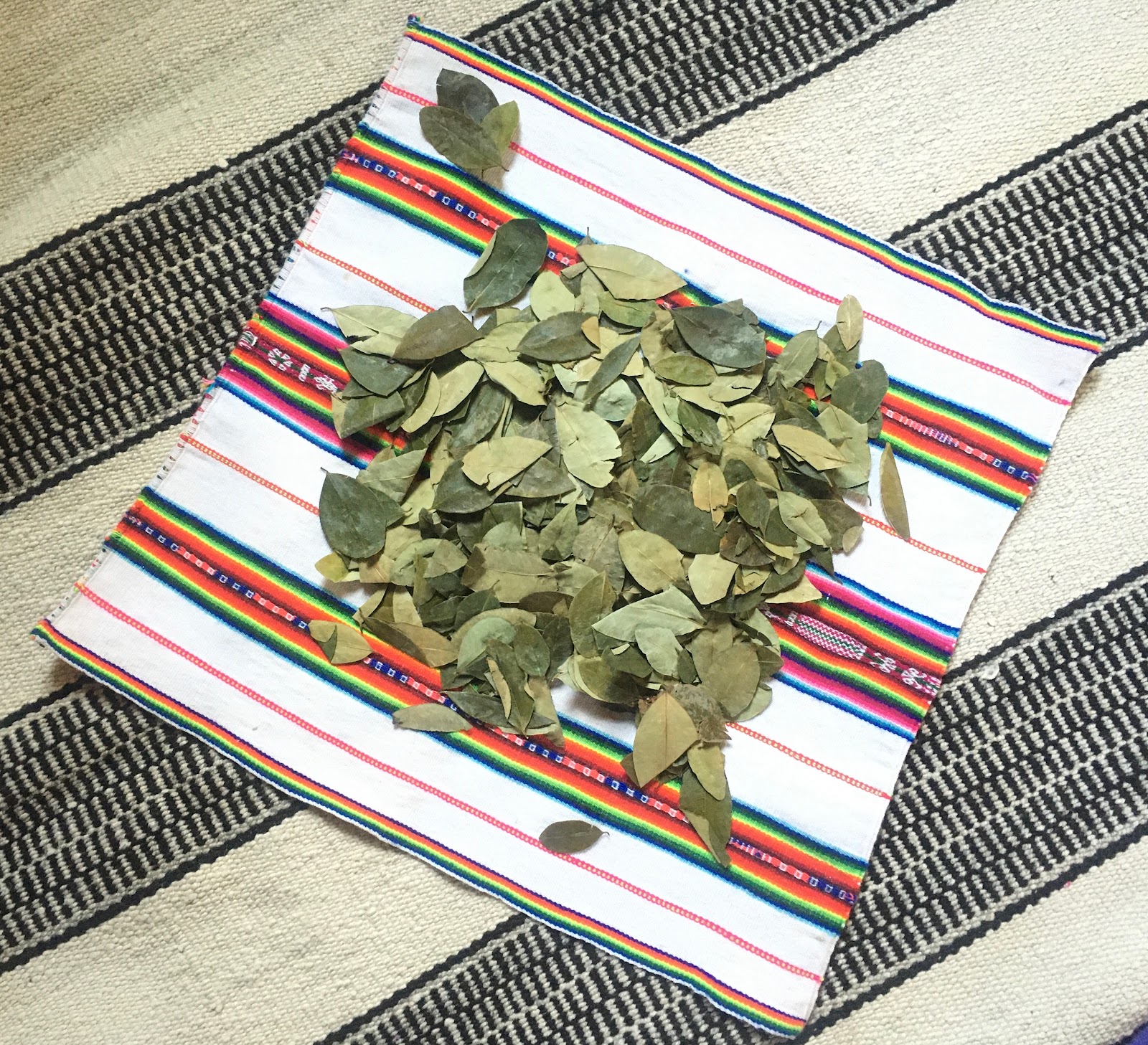
Coca is very special in the Andean culture. The leaves are used as a medium for prayer, as a divination tool, as a means for blessing. In its most simple usage, coca leaves are given and exchanged as a gift and a greeting, almost like a handshake. With the exception of certain festival dress, Chuspas are only worn by married men. They tie the bags around their waists for convenient quick-release use. 

How to tie your fabric bag around your waist 

So much of women's clothing is without a pocket, these soft bags become an instant pocket. You can carry it as a crossbody bag, or if the strap is long enough, you can tie it around your waist as a real pocket. I personally have a wardrobe of various colored chuspas and love that  I can DANCE IN MY PURSE! You can see some of these fabric bags for sale on our Etsy site: Taquile Friends The following video shows how you can tie it on for quick-release.


How Coca and Chuspas are traditionally used on Taquile

Exchanging coca

If two men meet on the trail and stop for a brief chat, they will open their chuspas, take a few leaves and place it in the other man's bag, usually simultaneously with their companion. In this everyday ceremony, leaves are not received directly in the hands, but always on cloth (or plastic bags): the top point of a hat, a pocket, a shirt tail, a woman's headcovering. Often they will observe if a well-shaped leaf lands right side up, an indication bringing good luck. They then may take leaves into their mouths, often combining them with a small amount of leupta, an alkaline ash substance that activates the medicinal qualities and makes the mucous membranes of the mouth slightly numb. 

In English, we commonly say we "chew" the leaves, but really, chewing is minimized. The leaves are tucked between cheek and gum, worked gently, and moved around in the mouth. The Quechua word we use on Taquile is something like pictchar, not masticar. Medicinally, coca lends energy, suppresses appetite and thirst, helps somehow with high altitude blood/oxygen and also with digestion and glycemic response. 

A simple coca leaf ceremony is for an individual to select three leaves from their own stash, be it their chuspa or plastic bag, choose three well-shaped leaves and imbue them with their prayers and intentions, then bury or burn them as an offering. These three leaves are called a k'intu. We always do this offer them to the water, "pay the lake," when commencing the sometimes perilous trip across Lake Titicaca.

Estalia Ceremony

A deeper coca leaf ceremony uses a specially woven cloth called an estalia. On Taquile it is traditionally white and red. Coca leaves are unwrapped from the cloth and each person selects his or her own k'intu. These are at least three leaves, and often multiples of three, especially nine leaves. These prayer-filled leaves are then taken by the designated shaman to be offered. Sometimes they will be placed on a paper with various elements, such as sugar for sweetness, flower petals for beauty, wine and alcohol for medicine, and even money or small drawings of desires and intentions. This wrapped paper is called a despachio; you might think of it as a dispatch or message to the spirit world. The markets in the cities often have sections with offerings of all sorts of items intended for inclusion in sacred despachios. 


On very special occasions, such as Easter, many more k'intus are made and offered, and complex despachios are given. On Easter, on Taquile Island, the Patchamama is "paid for the entire year." 

I tell about these ceremonies from my own experience over our many visits since 1986. Other parts of Peru certainly have their own versions of these sacred ceremonies. You can see more of my stories if you delve back into past posts. Please follow if you enjoy what you see. I don't post frequently unless we are actually in Peru, though our 2020 visit might deserve non-consecutive stories, since I was unable to post for the latter part of that visit.


Thursday, February 4, 2021

Textiles sales online

NEW ETSY site for Taquile Textiles

With art fairs restricted this year, we have opened an Etsy site to sell the textiles. 
Check it out at: Taquile Friends
I am telling the story of our project of Solar on Taquile, and our 35+ year relationship as well as offering the high quality textiles. So far most buyers have been positive and given us good reviews.

We have some stunningly beautiful hand woven scarves:


Also quite a few of different styles of winter hats: round topped beanies, pointy topped earflap hats and many more.


We have a beautiful selection of cell phone cases and chuspa medicine bags.


We have already sold out of full fingered gloves and just have a few open-fingered gloves yet.

Do check out our shop! If you scroll down past the listings, you will see more of our story.

Monday, July 20, 2020

Repatriation Blues

Repatriation in three versions

Due to the Pandemic, we stayed on Taquile for five months in 2020, January to June, under Peruvian lockdown after Mid-March, in safety, and experiencing Taquile culture in the absence of tourism.

Here's the Short Version:
Sam and I were “stuck” on Taquile an extra two months this year, with no tourists, after the March 16 quarantine declaration. It was actually pretty cool and safe, with no nearby cases for quite awhile, then just a few in all of Puno province. Under the Peruvian stay-home orders, we Taquileños simply considered the shoreline as the walls of our “house,” and lived as a community. When Sam and I finally got our tickets to repatriate, our journey was expensive and arduous (overland from Taquile to Lima), but we got home to liberate our dedicated house sitters here in Colorado and in time to plant a garden.

Here's the Long Version:
When the Peruvian Government declares the emergency and initiates quarantine lockdown on March 16, we still have a couple of weeks to go before our scheduled flight home. I rescheduled the LATAM flight from Juliaca to Lima from April 3 to the April 7 date of our US flight.  Our goddaughter and her family live in a fairly crowded neighborhood on a hill in the capital city of Lima, which is starting to report coronavirus cases so we will skip our few days visit with them this year.
So I’m in no big hurry to leave. Except that our Peruvian visas expire on April 9.

So we gather up our courage and take the boat to Puno with Silvano and Ruperta on March 30. We need to get money out of the ATM, and to extend our visas at the Peruvian Consulate. It’s also a supply trip: rice, oil, flour, salt, and treats: bread, cheese, chicken, avocados, olive oil. We have no trouble getting our money, but the Consulate has been closed for two weeks. We will try to renew it online.

We dress as Taquileños, Sam with a vest over his traditional shirt, me with three skirts and a chuko over my head. We wear masks over our nose and mouth, as does everyone in Puno. Military or Police are on every major street corner making sure everyone is wearing a mask and keeping distance. In the line at the bank, they call out “dos metros, dos metros” to keep the line spacing at two meters between each person. 
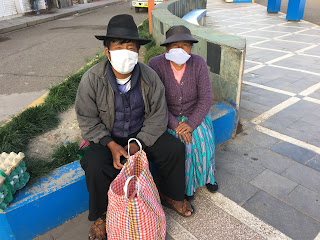
On the boat, we enjoy a nice conversation with the Taquile woman who brings produce to Taquile every week. We have a very official letter from the authorities on Taquile Island, explaining that we have been on Taquile since January 12 and that we are helping the Taquileños. When the boat docks, our captain, Elias, tells us to stay in our seats; we will be the last ones off. Then he urges us to close the curtains, warning that the press is there! Two coastguard officers come on the boat with their machine guns and wearing masks (as we all are). They photograph our letter and our passports and tell us to be careful. The press is gone by the time we get off the boat, but later we see a video from the local television station. In the interview with our produce lady, when asked if there are any tourists on Taquile, she tells them no. She is accurate, actually, as we are not tourists on Taquile, but family members. 

Again when we leave Puno the next day, the coastguard officers photograph our documents again, and wish us a pleasant boat ride to return to Taquile. Machine guns and all.

We hear rumors of foreigners being arrested and removed from the nearby peninsula; we can’t imagine where they are being taken, but we don’t leave the island again until we are on our way back to Colorado, two months later. I begin to wear traditional Taquile clothing every day, to blend in. From a distance I look like every other Taquile woman if you don’t notice my glasses. The Taquileños like this and compliment me. 

We register with the U.S. Embassy’s Smart Traveler Enrollment Program (STEP) and begin receiving notifications about repatriation flights. We also learn that the Peruvian Government has automatically extended all foreigners’ visas until 45 days after the quarantine ends, thus solving that problem. And the US Government extended the deadline for filing taxes to July. So now we are truly happy to stay where we are.

A non-profit organization, Warrior Angels Rescue (WAR), looks like our best way to get home. They run on donations, and we will be happy to contribute. They have one flight all scheduled for early May, and are planning another which would fly us from Arequipa and we could avoid the longest of overland travel. Suddenly their flight is blocked by the US government from landing in the United States. Travelers waiting at the airport, passports already stamped, had to return to wherever they were staying. The US Embassy offers the only official flight on Easter Airlines for $2050 per person from Lima to Miami, a flight that cost $200-$400 before the border closure due to COVID-19. We consider this high price as price-gouging, a result of some sort of corruption and refuse to participate. Other flights are also announced, still overpriced at $1300. So we stay on Taquile and help out as best we can.  Future blog posts will feature our extended stay on Taquile.

We join several social media groups of people stuck in Peru and follow them on our cell phones on Taquile. Most people are much worse off than we were.  We made the following video for WAR to use in their fundraising.

The weeks keep passing by, and some slightly more reasonable flights are offered. One day, Saturday, May 30, we see a flight for $1000 each that includes luggage. We jump on it; make our reservations immediately. The confirmation comes through while we are playing volleyball high above the plaza and I duck out of the game to make our payments. When we tell our teams that we will be leaving for the US within a few days, they are surprised and shocked.

Getting home is arduous and long.  Here it is in 12 steps:
1. Monday. A two mile hike to the boat with luggage (lots of help) down the famous 500 steps. 
2. Three hour boat ride to Puno; last minute purchases; overnight in Taquile albergue. 
3. Tuesday. Five hour ride in private van from Puno to Arequipa; meet our travel partner in her hospedaje, rest and await our 8pm transportation. 
4. Seventeen hour overnight combi ride to Lima; carsickness. 
5. Wednesday. Carried luggage two blocks to AirBnB since security measures closed street; buy food at convenience store, cook, eat and sleep overnight. 
6. Thursday. Carried luggage back to meet taxi at 5:00am for 1/4 mile ride to meet busses for shuttle to airport; two hours waiting on bus (bathroom available). 
7. Check-in sitting in plastic chairs under a tent at the Peruvian Air Force Terminal (commercial airport closed). Bring our own food and water both for waiting and for the flight. Bus across tarmac to airplane.


 8. Still Thursday; plane take off about 10:30am. Flight from Lima to Miami. Arrive 4:30 pm. Eat, sleep. Overnight in airport hotel. 
9. Friday. Flight to Houston leaving at 6:30am. 
10. Flight Houston to Denver. 
11. Beautiful private car drive over the Rockies; 5 hours to Grand Junction and our car. 
12. Drive ourselves from Grand Junction 1 1/2 hours to Paonia and HOME.
A drive through Glenwood Canyon

HOME


Friday, January 24, 2020

More great kid friends!

KIDS ARE THE BEST!

We have found time to play with our kid friends. High priority!
Rolando with his new book from Daniella

Lisbeth and Sam with the flying  ring

Lesdy helps at her mother's retaurant by keeping the buckets full. Bucket flush is the technique.

Little Chico has totally warmed to Samuel, and rests on his lap.

These girls are growing up, but we still play hide and seek in the Ruins above their house.

Archeology

A COUPLE ARCHEOLOGICAL SITES ON TAQUILE

Taquile is ancient, pre-Incan, and several sites can be found, Some quite major, others small secret places.

The highest point on Taquile, I will have to add photos later, or check out previous years' posts of Mulcina.

Many places are poorly preserved, and the National Cultural Preservation people (or some international group) would be well to step in. This following picture shows how the doorway her is opening a gap that may fall one of these days.

I am pointing to a gap that wasn't always there.
 I found this small round disk with a hole in the middle, apparently carved stone (though might be ceramic), in our playground ruins. The young girls tell me they are ancent and they find them now and then.
This wasn't always in this spot.
 This entrance to our playground ruins is covered with lichen. When we firt came, 34 years ago, the lichen was much less abundant. We were told that it is an excellent natural dye. However, as important as textiles are here, it is an island. Very little natural dying is done any more, and the lichens have recovered.

Beautiful Taquile

RICH GREEN OF THE RAINY SEASON

Southern Hemisphere summer brings rain and agricultural growth. This post is mostly pictures of the breathtaking beauty of this island.
View from the highest point on the island, the Ceremonial Site, Mulcina

Classic gate used to keep sheep in place. Note sandal soles for hinges.
 Many rocks are sedimentary, able to be split along the layers.
Note strata

Thatch roofs

Add caption
 Some say you cannot swim in Lake Titicaca, but this beach curvs around a relatively shallow bay that can warm quite nicely on a sunny day. White sand perfect for beach volleyball, sand catles, or just hanging out. Once in a while the family makes it an outing. Not yet this year, but we will!
La Playa
 
Two Taquile women round the corner.
 Many sheep are being born this time of year.
Baby black sheep huddles from the wind.
 Look closely at the horizon line below, the magnificent snow-capped peaks of the Bolivian Cordillera Real appears among the clouds. In rainy season, we are always blessed for this view. I thought the arch made a fine frame, but here we have one of many half-finished houses on the Island.

moist, mossy wall along the trail.


Wednesday, August 28, 2019

Scholarship fund

Help Ivan's education
Go Fund Me page Please share this page.

Ivan Huatta Quispe is an indigenous Quechua speaker from Taquile Island, Lake Titicaca. His family runs a homestay business and has a boat that ferries tourists from Puno to Taquile Island. He is the first in his family, and one of the very few Taquileños to pursue higher education. 

During summer vacations in high school, Ivan worked driving the boat and could see that skill as a boat (auto) mechanic would be an excellent career, one where his skills would always be in demand, so he told his father he wanted to receive this training. In high school he was School President during the 2017 school year, a confident leader honored by his classmates and teachers.

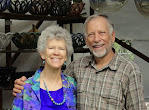
Sam Brown and Tara Miller of Colorado, by virtue of how they participated in the profound ceremony of his parents' wedding, consider themselves to be his grandparents (They have been visiting Taquile since 1986, helping with solar energy on the island community). They paid for his first year at the SENATI Institute of Higher Learning in Puno, Peru, in 2018. 

The mechanic certification is a three-year program, and includes not only hands-on engine mechanics, but foreign language, communications, history, civics--in short, a full and well rounded higher education program. Ivan completed his first year with excellent marks and appreciation from his professors as well as the Institute's administrators. 
41623606_1566962077513129_r.jpeg
Very professional mechanic hands-on training (with uniforms!)
In 2019, with the approval of the Institute, he took the year off to help his family. His father was holding an important and demanding office in the Taquile community and needed help from Ivan, his eldest son. This office ends in late 2019, and SENATI has held his place to resume his education beginning in February of 2020.  We, his "grandparents," were concerned about his taking the year off, but we came to see, not only the value to his family, but the strength of his commitment to complete his education. He has matured during this year off and will be returning with renewed vigor and commitment. He will be age 20 in 2020.

His tuition is a reasonable $100 per month, with additional expenses of books, computer upgrades, uniforms, special courses and living expenses. This funding request is for the main expenses of the full remaining two years of his education. Sam and Tara will be returning to Peru in January-April of 2020, and will bring the funds available at that time. Sam and Tara are committed to this scholarship and will make sure Ivan's education is supported. Money raised in this Go Fund Me will be a significant help in furthering this goal. 

Link to: Ivan's Funding site
In his school uniform on the roof overlooking Puno Port.

Saturday, January 26, 2019

How to Visit Taquile, Updated

Take the Collectivo Boat!

The tour guides in Puno will try to talk you into their tours, but you help the local Taquile economy better--and save yourselves some money--if you take the collective boat. The boats are comfortable and safe. All you have to do is go to the port at 7:30am. Stop at the very first office on the left, clearly labeled ISLA TAQUILE and buy your round-trip ticket, currently S / 30, which includes entrance onto the Uros floating islands as well as the Taquile entrance fee.
Photo: Delfin on the boat dressed in traditional clothing with Taquile Island in the background.

Taquile is a walker's paradise, incredibly beautiful with terraced fields, views across the blue Titicaca lake water of the Bolivian snow-capped mountains, and skilled fiber art. Plan to stay at least one night, better two! Most touists stay for only a few hours, and have a very limited experience. Plan also to buy tejidos (textiles), either from the artisan's cooperative or directly from your host or other family. This weaving is among the best in the world recognized by UNESCO, very fine double warp patterns. Your purchase helps keep the technique and the villagers alive.

Years ago, only Taquile owned boats could dock on Taquile, but federal regulations have denied the Taquile community the control over tourism that they used to have when ALL the boats allowed to dock on the island were communal Taquile boats. The tour boats usually do not allow the locals to ride on their boats, so your oat ride will be a much less colorful experience.

After the 3-hour boat ride, you arrive on the East side of the island, so avoiding the famous five hundred-stair hike up to "the arch." You will hike down those stairs for the return boat to Puno, leaving daily at 2:00pm.

 STAY OVERNIGHT, OR EVEN TWO, IF YOU CAN! Ask to be assigned to a host family. or better yet, Ask to stay with Silvano's family. Tell them you heard about him from Tara y Samuel. Silvano and Ruperta will cater to your dietery needs and have a fine kitchen and dining room, flush toilets and even a hot shower. They will guide you if you wish, or point you in the right direction. Silvano speaks enough English to help you with everything.

Rooms are basic: clean and with plenty of blankets; currently the community certifies the tourist comfort of the rooms. Bring fresh fruits and vegetables from Puno as a gift to share with your host family; you can buy meals from them. Note, once you get up he hill you'll be at nearly 13,000 ft or over 3800 m., so be sure to take it easy and drink plenty of fluids.