Showing posts with label Solar energy. Show all posts

Thursday, February 26, 2026

40 years, 23rd visit

 2026, 40th anniversary 

Our first visit to Taquile Island, as tourists, was in 1986. On that trip too big things happened: 1)We caught the dream of bringing a Taquileño couple to the United States. 2)We observed that Taquileños had no dependable source of electricity on the island.  

The results were that we brought that couple to the United States in 1988. It was magical, full of serendipitous meetings and fun (You can read about it on the earliest posts of this blog). And that led to us becoming godparents and coparents, and even parents and grandparents, with deep relationships in this beautiful community.

The other result was that we returned in 1988 with the first solar electric panel, thereby introducing solar to the island. Now many houses have rooftop solar and the entire island has large community array, feeding inverted power to all the houses. You will see many of these stories throughout this blog.

Traditional “pollo broaster” dinner

So this week we are back for the 23rd time, having visited mostly every other year or every year with a few gaps. We don’t think of this as tourism at all, but our other life with our beautiful indigenous family of Taquile Island.

First, we stay in Puno, the “folkloric capital of Peru” the big city by the bay where we will catch a boat to the island in the morning. Here are a few pictures from Puno:


Thursday, March 12, 2020

Solar Renewal in Llachon

Fire destroyed Solar Power in Llachon Home
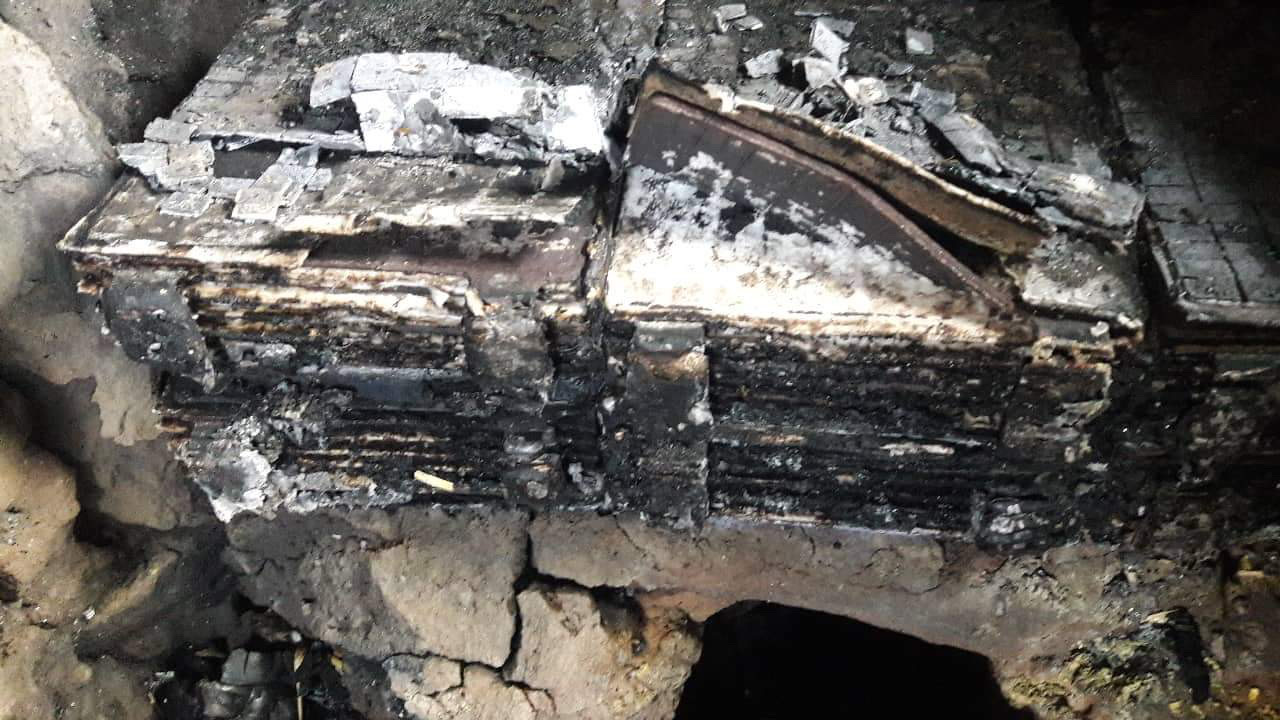
On January 18, a fire in the little kitchen in Asunta and Armando's home in Llachon, on the Capachica Peninsula, started at the 5 gallon propane tank and spread throughout the kitchen. The solar panels were mounted on the roof above the kitchen. When the fire spread to the battery, it exploded. The family had run far from the fire before the explosion, fearing that the gas bottle might blow (it didn't), and no one was hurt. Neighbors rushed to help and buckets of water saved the rest of the house.

This first picture is during the repair, as it will likely be the thumbnail for my Facebook Post, and I don't want to emphasize the battery!
So here is the battery and fire damage:
Panel fell, broke, and burned

Battery. You can see the plates.

Kitchen tools melted and destroyed
When we arrived the power was off!
The family had rigged up power from the neighbors after the fire, bringing a 220volt wire across the field so they could have lights and so Armando could play his electric piano. He is a serious composer and sometimes forgets to eat when he is deep at work. However, a lightning strike that morning had taken down the grid, which is fairly frequent in this town at the end of the power line on the Capachica Peninsula. We prepared dinner by headlamp and ate by candlelight, and decided that the solar system needed to be replaced.

Mariella Sarita, high school student who wants to be a lawyer when she grows up.
Last year the power had gone out all over Llachon and none of the students could study in the dark. Sarita was the only student who submitter her homework! Because her family had solar pwere, she had light to work by. After that incident, one other family in the village installed solar electricity!

Early the next morning, Sam and Armando and Silvano left before breakfast to go to Juliaca to buy and new panel and battery. Only it turned out that a big protest was going on in the city. 
Tires on fire and roads blocked in Juliaca
 They had to walk several more blocks than planned, and store doors were only open a crack until the marchers passed. Happily, they found willing merchants in the solar stores and found some good equipment. The charge controller was located in another room and had survived the fire. Testing it at the solar store proved its worth.
Solar store in Juliaca testing the charge controller.
Assembling the equipment
As soon as the guys got back to Llachon, we started assembling all the parts, including testing the second 100w panel that seemed to have survived the fire. After the soot was cleaned off, it was fine!
Uniting and wiring two 100w panels
 Installing the panels on the roof:
Young Jhoel keeps positive and negative wires separate
Asunta had been working on a new and colorful manta.
Of course, one of the main reasons we went to Llachon in the first place was to visit Kusi and her new 7-week old baby boy. He was slightly premature in his birth, but is progressing nicely. He was awake enough for a little baby bouncing on Tara's part.

Jhoshua with mama Kusi
 It rained all morning in Llachon while the guys were in Juliaca, but we did life--
Jhoel with the sheep
 I actually got to make a drawing from the shelter of their comfortable comedor (dining room) looking out this big picture window. My drawing was in the early misty light, but then the sun came out:
Asunta and Armando actually do have a room to rent for tourists. If you ever want to stay overnight on Capachica, it's a sweet place to stay--PLUS IT'S SOLAR POWERED!


Saturday, January 26, 2019

Clean Energy

Efficiency and Solar

Over the years we have promoted and helped to build chimneys on bio-fuel stoves. Otherwise kitchens can be horribly smokey. Some of our older beloveds have persistent coughs from years of smokey kitchens. Easier than making one from scratch are these ceramic two-burner stoves. Last year our supplier, an excelent solar store called ElectroSol, didn't seem to be able to keep them in stock. We wanted one for our goddaughter, Natalia and her husband, German, especially with their sweet new baby, Rolando. This year we bought one for them! Happy people!

Carrying the new stove on a bicycle taxi.
This year it looks like our main solar PV projects will be to repair or upgrade systems from past years that aren't working quite right. Here is Sam in the solar store with a new panel. We also got a battery and should be able to install them next week.
Sam shows off in the Solar store.
 Maybe pictures will be added with the installations when I'm back in Puno in a few weeks. Stay tuned!

Sunday, December 9, 2018

A Solar Project with Heart

By Tamie Meck, Published in the Delta County Independent, Wednesday, November 28, 2018, the Back Page. This article followed a delightful interview with Tamie in our home, and we are grateful for her kind and thoughtful story. I have made a slight factual corrections, in particular about the history of solar in Southern Peru.

A solar project with heart

When Paonia potters Sam Brown and Tara Miller married in the mid-1980s, they imagined selling their handmade pottery and living a simple life. She was educated in literature, he had a background in zoology, natural resources and recreation, and they shared a desire to visit the world's great mountain regions. "We live in Colorado," said Sam. "We love mountains."

In 1986 they took their first trip, to Peru and the Andes Mountains. The trip changed the course of their lives, and in turn, changed the lives of others.
Solar panels provides power for homes on Taquile Island, Lake Titicaca, Peru. Paonia potters Sam Brown and Tara Miller first visited more than 30 years ago, and over the years have helped bring solar power to the remote island while helping to market the beautiful textiles.

In the 1970s, Tara enrolled in an evening pottery class while teaching high school English in Coos Bay, Ore. Soon after, she took a year off and focused on her pottery skills. In the early 1980s she moved to Aspen to make picture frames for her photographer sister, and in 1982, began working solely in the pottery studio, studying under some of the biggest names in the field.

Her specialty was heavy ceramic mugs decorated with aspen leaves applied through a resist technique. They sold quite well in the local shops. In 1983, Tara met Sam, a National Parks Service back-country ranger stationed at Rocky Mountain National Park. Shortly after, he took off on a year-long assignment to Alaska, returned to Aspen, and joined Tara in the clay studio.

Sam added Rocky Mountain themes like elk, native birds, aspen trees, fishermen and skiers to Tara's motifs. Themes they continue to use today. "Our pottery sells well as long as we stay within the Rocky Mountain theme," said Sam.

Their trip to Peru took them to Lake Titicaca, located at almost 12,500 feet at the base of the Andes Mountains. A two-hour boat ride from the city of Puno took them to Taquile Island.

A terraced island of just over two square miles, Taquile's economy is based on agriculture and tourism. It has largely avoided outside influences for centuries. As a result, said Sam, there are no cars, bicycles, dogs or guns on the island. As they have been for centuries, major decisions are made collectively. Recently the residents thwarted efforts to commercialize and build hotels.

"It's a real peaceful society," said Sam. "You walk everywhere."

Taquile is known worldwide for its fine textiles, made using centuries-old knitting and weaving techniques, and from which their colorful and traditional clothing is made. In 2005, Taquile's textile arts were proclaimed "Masterpieces of the Oral and Intangible Heritage of Humanity" by UNESCO.

Most tourists stay a couple of hours, take photos and buy textiles before heading back to Puno. Sam and Tara planned to stay two nights and were assigned a host family.

One modern technology only beginning to be introduced in the region was solar power, but it was unknown on Taquile Island. What little power they had came from lead-acid batteries. Charging them meant a three-day round trip to Puno. Tara and Sam knew about solar power both through association with the Rocky Mountain Institute and through a new renewable energy program at Colorado Mountain College in Aspen, which in 1991 would morph into Solar Energy International. The environmental risks of the lead-acid batteries were a big concern, they said.

Their host couple were weavers. They showed Sam and Tara their beautiful textiles and shared their dream of going to America to sell their goods and teach their craft.

"Being craftspeople ourselves, we bought into the dream," said Tara. Their two-night stay turned into a week. In 1988, they returned, smuggling in a 9-watt solar panel. They wired the panel to a radio and played music. To the residents, "It was like magic," said Sam.

Everyone wanted a panel, they said. They traded the panel for textiles, which they sold back home at local craft fairs, and re-invested the money in more solar panels to take with them on their next trip.

Taquile's inhabitants gained more than solar power, they gained a family. On Taquile, says Tara, "We're 'Madrina and Padrino,'" Godmother and Godfather.

Tara and Sam moved to Paonia in the early 1990s and set up their clay studio. It hasn't made them rich, but that was never the plan, they said. Tara began ceramic mugs, platters, bowls, planters, and other objects, and Sam made clay coil stoneware fruit/bread baskets. They were busy with family life, and in winters sold Christmas trees in California for Sam's family's business.

In the mid-1990s they returned to their Taquile family, and have returned almost every year, always packing solar equipment for trade. Back home, they sold textiles alongside their pottery. "We figure that was their currency because it's good stuff," said Sam. Since they only need to make enough to buy more solar equipment, the markup is small. Items sell well, and people who know weaving recognize the fine detail of the weaving and understand the skills required to make it.

Through the years Sam and Tara have also brought Taquile residents to America. One year the Smithsonian Institution hosted a group of Taquile residents. The Smithsonian paid their expenses, but when offered money, "They wanted solar panels," said Sam. "The Smithsonian had to run around and buy solar panels to pay them."

SEI moved from Carbondale to Paonia in 2002. When they offered a class on solar energy in the developing world, Tara and Sam gave a lecture on Taquile. Most lectures were filled with technical speak, they said. They spoke about smuggling solar panels into Peru, trading panels for textiles, and how much they loved the people. "We were the project with heart," said Tara.
Sam shares a happy moment with three young sisters on Taquile Island, Lake Titicaca, Peru, where he and wife Tara are known as ‘Madrina and Padrino,’ Godmother and Godfather.

Tara and Sam are still living simply and making pottery in the home studio. At the height of their career, they did as many as 12 craft shows a year. They could have had more lucrative careers, but instead made a conscious choice to maintain control of their lives. They wanted the flexibility that allows them to hike or travel and work in their studio. "We knew we were choosing the lower money route, but we were choosing a quality of life, other than a 9-to-5 job," said Sam.

After more than 30 years, they're cutting back on craft fairs and slowing production. They plan to create more local venues and set up shop online. The demand is still there, said Tara. She recently enlisted the help of an assistant to work in the studio.

They also plan to continue visiting their Taquile family. They recently established a program to provide school supplies to the local children. Two years ago, Brad Burritt and Danielle Carre with Empowered Energy Systems in Hotchkiss traveled to Taquile to install two small solar systems. Through a YouCaring campaign, they raised money and returned last year with son Asa, a solar installer who speaks Spanish, to teach a solar installation class. Four Taquile residents earned their diplomas and now have textbooks to refer to.
Paonia Artists Sam Brown and Tara Miller wear traditional clothing for the annual Carnival celebration on Taquile Island, Lake Titicaca, Peru. In 2005, UNESCO proclaimed Taquile Island’s centuries-old tradition of textile weaving and knitting as “Masterpieces of the Oral and Intangible Heritage of Humanity.”

Their positive influence on the island continues. Recently their godson was re-elected to town council. When a diesel fired water-pumping project was proposed, which would belch diesel smoke and not bode well with the tourists, he lobbied for solar, and won. Thanks to the resulting project, the island now has three water pumping systems, virtually eliminating the need to haul water.

Hauling water, said Sam, is considered one of the biggest jobs in the developing world. On one trip to Taquile they had to haul water, and almost cried when they got home and turned on the faucet. "It's so amazing that we have running water, both temperatures, and it's clean," said Tara.

On their most recent trip, they brought home dozens of textiles -- hats, gloves, scarves, belts and purses. Some pieces are tagged with the artist's name, type of wool used, and a short story. As they have for many years, this Friday and Saturday they will have a booth at the annual Holiday Art Fair at the Blue Sage Center for the Arts in Paonia.

Their years of work and visits to Taquile Island are documented in words and photographs at taquilefriends.blogspot.com.

       
###


Friday, March 2, 2018

Solar Workshops on Taquile

Taquile is nearly 100% Solar Powered
On our first trip to Peru in 1996,
we stayed on Taquile for a week. We learned that the popular way to have electric power--lights and music--was to carry a lead-acid car battery the hour or so hike to the boat, charge it for a day in Puno, and return on the third day for, perhaps, three to four nights of power. We immediately recognized a perfect application for solar energy and brought the first photovoltaic panel in 1988.

Since then, the community has created micro-credit programs to pay for PV systems, individuals have managed to finance them themselves. And even, in 2002, a cultural dance group brought to Washington, D.C., got the Smithsonian to rush around and pay them in solar panels instead of money!
Sam and I used to bring panels, but now solar is available in several stores in local Puno and Juliaca as well as throughout Peru. Now we bring efficient LED lights and charge controllers, USB ports, voltmeters, inverters and various other accessories for the solar PV systems. We also buy equipment in Puno and then trade textiles for the equipment.

Last year, when our Colorado friends, Brad Burritt and Danielle LeCarre of Empowered Energy Systems, came to Taquile, they could see a need for further education, how PV systems here are getting large enough that it is time for some safety and more advanced expertise. So this year, thanks to community funding, advance training came to Taquile.
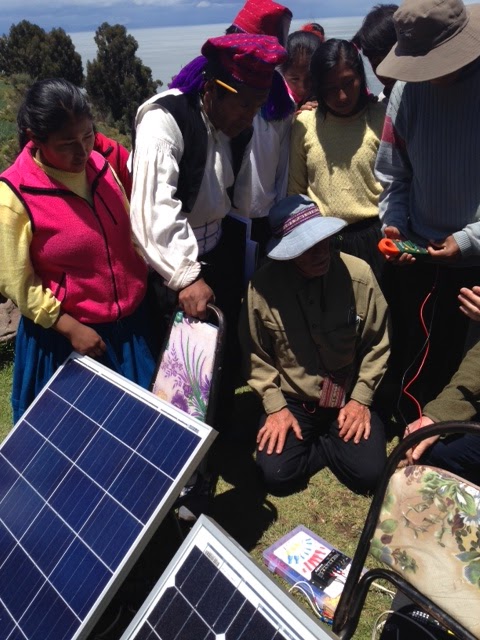
Asa Burritt speaks Spanish fluently. With Spanish-language teaching materials donated by Solar Energy International, he brilliantly taught a group of Taquileños advanced principles of photovoltaic system theory and design and application. Of course, he had help from his solar expert dad, Brad Burritt.

We held the class at our house, and at least a dozen people attended some or part of the course.

learning to test a solar panel

more testing under charge and use
Juanna was the only woman to attend the advanced course, but she slipped away and missed some important education. Taquile work is strongly gender specific, but we had hoped she would be one of our maestras. Maybe next time.
Meters for testing are important tools.

In the end, four men, German, Silvano, Delfin, and Elias (not pictured)  completed the course and received, not only certificates of recognition, but meters and reference books. Our final course activity was to make a full installation at the home of single mothers. Below is Maria, the happy recipient of a professionally installed solar electric system.

A primary goal of the course was to educate a few maestros, masters of solar technology, who would be the experts whom other Taquileños would call upon to solve their PV problems. These four were introduced in general maintenance classes held in the municipal building. Altogether, about 25 people attended the general class. We had hoped for more, but the word will spread.
After the workshops, Brad and Asa were invited to lavish lunches accompanied by requests to check out various systems. Below, Fredy's two panels are evaluated.


Thursday, January 25, 2018

Preparing for Solar Installation

A household of single women will receive a solar installation, thanks to the YouCaring fundraiser created by Empowered Energy Systems, Brad and Danielle Burritt (see blog post December 2018).

Our dear friend, Fredy Huatta, is now married to Rita and they have a sweet a little 2 year old. Her mother and sister live in a house with an ancient, cracked and barely functional solar panel. Rita sometimes stays here when Fredy is working with his boat and as a guide from Puno.

When we came to measure the house for wiring, and plan the installation, the women made us a fantastic meal:
Chicken Soup and Trout--with potatoes and chuno and corn
We also made a coca-leaf ceremony, offering our prayers for a successful installation, as well as blessings on the union of Rita and Fredy.

So our first trip to Puno includes buying solar panels and batteries:


2018 First week

Arrival on Taquile
We arrived in Puno on Thursday, January 11, after over 24 hours of travel, we met at the Juliaca Airport by Silvano (our son by virtue of being his padrinos de matrimonio) and Fredy, beloved young man we've known since baabyhood. A happy, happy reunion. Friday was a day of shopping for supplies and then immediately on Saturday to Taquile, where the rest of the family helped us carry all the bags and bundles up to the house where our old room and lunch were waiting.

After lunch, a volleyball game broke out. One wonderful thing that happens while we are here is that extended family and friends get together in ways they never do in ordinary daily life. Rains have been regular and everything is green and beautiful.


We slipped away from the games to visit our goddaughter, Natalia, who has recently given birth to a baby boy, Roland Bradley, here wrapped in a crocheted blanked made by my mother, Irene Miller:

Taquile citizens have learned that we bring solar gear for sale or trade, this year our goodies include charge controllers and inverters, efficient LED lights, USB ports and battery voltmeters, as well as rechargeagle headlamps and flashlights. Within a couple of days we have traded or sold a large percentage of what we brought.
controller, inverter and lights traded at Rosa's family
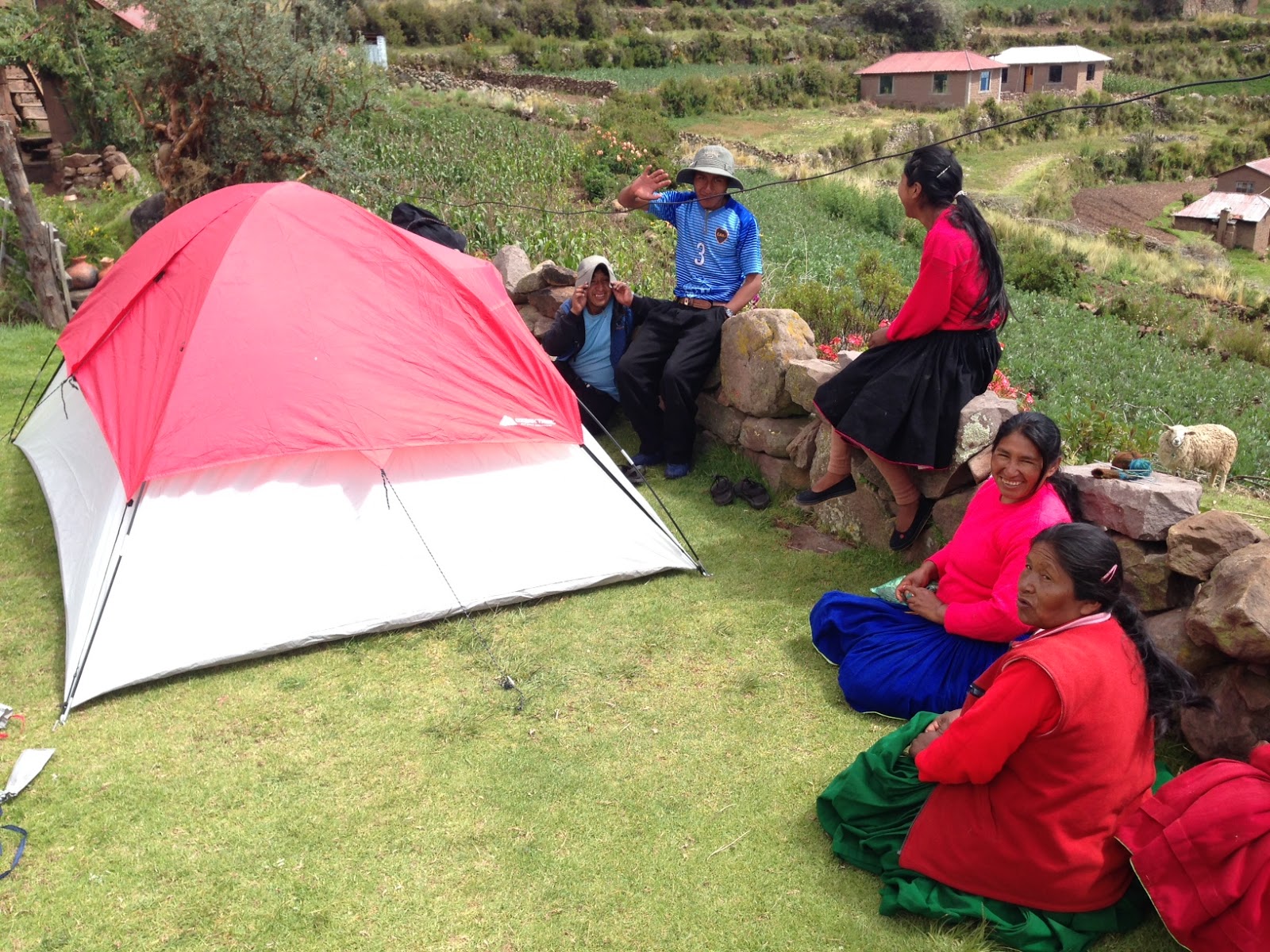
The winter season, is the time to preserve their staple, potatoes.  The technique is to freeze the potatoes at night and then, after they thaw in the day, step on them to break the membranes so the water can evaporate and dry. Thus they can be stored for years. Since global warming, they can no longer do this job on the island and the family has to take their potatoes to a higher altitude place on the mainland to make chuño, or freeze-dried potatoes. To help make this more comfortable, we brought a tent!

The various families will share the tent, and, ¡wow! were they happy!

We also brought gifts of objects and money donated by the many godparents and friends of Taquile who help us make a difference here. !THANK YOU!

It wasn´t all trades and gifts, though, Clever turned Edith's plate of egg and potatoes with tomato into a bearded face!
 And some baby chicks were hatched at Celbia's house. Lizbeth loves their soft fuzzy life:

The school system suffered a teacher's strike last year, so the school year went late. This is the first time we have been privileged to witness the closure of the school year, something like graduation in the US, with honors presented to special students. Our grandson, Ivan was president of the school last year and this photo shows him passing his regalia of office to next year's president, a girl for the first time in history. About time, I say, but Ivan says the boys aren't so sure.

Back at home, Clever and Ivan are in a fierce competition, a chess tournament:
They take time to teach young Charles how to play the game.
Everywhere we go, women are weaving, getting ready for Carnaval:
Kusi has almost completed this chuspa, or coca purse

Alicia, Celbia and Kusi get social with their weaving
And, of course, we meet up with our little kid buddies and play games.