Showing posts with label travel advice. Show all posts

Monday, July 20, 2020

Repatriation Blues

Repatriation in three versions

Due to the Pandemic, we stayed on Taquile for five months in 2020, January to June, under Peruvian lockdown after Mid-March, in safety, and experiencing Taquile culture in the absence of tourism.

Here's the Short Version:
Sam and I were “stuck” on Taquile an extra two months this year, with no tourists, after the March 16 quarantine declaration. It was actually pretty cool and safe, with no nearby cases for quite awhile, then just a few in all of Puno province. Under the Peruvian stay-home orders, we Taquileños simply considered the shoreline as the walls of our “house,” and lived as a community. When Sam and I finally got our tickets to repatriate, our journey was expensive and arduous (overland from Taquile to Lima), but we got home to liberate our dedicated house sitters here in Colorado and in time to plant a garden.

Here's the Long Version:
When the Peruvian Government declares the emergency and initiates quarantine lockdown on March 16, we still have a couple of weeks to go before our scheduled flight home. I rescheduled the LATAM flight from Juliaca to Lima from April 3 to the April 7 date of our US flight.  Our goddaughter and her family live in a fairly crowded neighborhood on a hill in the capital city of Lima, which is starting to report coronavirus cases so we will skip our few days visit with them this year.
So I’m in no big hurry to leave. Except that our Peruvian visas expire on April 9.

So we gather up our courage and take the boat to Puno with Silvano and Ruperta on March 30. We need to get money out of the ATM, and to extend our visas at the Peruvian Consulate. It’s also a supply trip: rice, oil, flour, salt, and treats: bread, cheese, chicken, avocados, olive oil. We have no trouble getting our money, but the Consulate has been closed for two weeks. We will try to renew it online.

We dress as Taquileños, Sam with a vest over his traditional shirt, me with three skirts and a chuko over my head. We wear masks over our nose and mouth, as does everyone in Puno. Military or Police are on every major street corner making sure everyone is wearing a mask and keeping distance. In the line at the bank, they call out “dos metros, dos metros” to keep the line spacing at two meters between each person. 
On the boat, we enjoy a nice conversation with the Taquile woman who brings produce to Taquile every week. We have a very official letter from the authorities on Taquile Island, explaining that we have been on Taquile since January 12 and that we are helping the Taquileños. When the boat docks, our captain, Elias, tells us to stay in our seats; we will be the last ones off. Then he urges us to close the curtains, warning that the press is there! Two coastguard officers come on the boat with their machine guns and wearing masks (as we all are). They photograph our letter and our passports and tell us to be careful. The press is gone by the time we get off the boat, but later we see a video from the local television station. In the interview with our produce lady, when asked if there are any tourists on Taquile, she tells them no. She is accurate, actually, as we are not tourists on Taquile, but family members. 

Again when we leave Puno the next day, the coastguard officers photograph our documents again, and wish us a pleasant boat ride to return to Taquile. Machine guns and all.

We hear rumors of foreigners being arrested and removed from the nearby peninsula; we can’t imagine where they are being taken, but we don’t leave the island again until we are on our way back to Colorado, two months later. I begin to wear traditional Taquile clothing every day, to blend in. From a distance I look like every other Taquile woman if you don’t notice my glasses. The Taquileños like this and compliment me. 

We register with the U.S. Embassy’s Smart Traveler Enrollment Program (STEP) and begin receiving notifications about repatriation flights. We also learn that the Peruvian Government has automatically extended all foreigners’ visas until 45 days after the quarantine ends, thus solving that problem. And the US Government extended the deadline for filing taxes to July. So now we are truly happy to stay where we are.

A non-profit organization, Warrior Angels Rescue (WAR), looks like our best way to get home. They run on donations, and we will be happy to contribute. They have one flight all scheduled for early May, and are planning another which would fly us from Arequipa and we could avoid the longest of overland travel. Suddenly their flight is blocked by the US government from landing in the United States. Travelers waiting at the airport, passports already stamped, had to return to wherever they were staying. The US Embassy offers the only official flight on Easter Airlines for $2050 per person from Lima to Miami, a flight that cost $200-$400 before the border closure due to COVID-19. We consider this high price as price-gouging, a result of some sort of corruption and refuse to participate. Other flights are also announced, still overpriced at $1300. So we stay on Taquile and help out as best we can.  Future blog posts will feature our extended stay on Taquile.

We join several social media groups of people stuck in Peru and follow them on our cell phones on Taquile. Most people are much worse off than we were.  We made the following video for WAR to use in their fundraising.

The weeks keep passing by, and some slightly more reasonable flights are offered. One day, Saturday, May 30, we see a flight for $1000 each that includes luggage. We jump on it; make our reservations immediately. The confirmation comes through while we are playing volleyball high above the plaza and I duck out of the game to make our payments. When we tell our teams that we will be leaving for the US within a few days, they are surprised and shocked.

Getting home is arduous and long.  Here it is in 12 steps:
1. Monday. A two mile hike to the boat with luggage (lots of help) down the famous 500 steps. 
2. Three hour boat ride to Puno; last minute purchases; overnight in Taquile albergue. 
3. Tuesday. Five hour ride in private van from Puno to Arequipa; meet our travel partner in her hospedaje, rest and await our 8pm transportation. 
4. Seventeen hour overnight combi ride to Lima; carsickness. 
5. Wednesday. Carried luggage two blocks to AirBnB since security measures closed street; buy food at convenience store, cook, eat and sleep overnight. 
6. Thursday. Carried luggage back to meet taxi at 5:00am for 1/4 mile ride to meet busses for shuttle to airport; two hours waiting on bus (bathroom available). 
7. Check-in sitting in plastic chairs under a tent at the Peruvian Air Force Terminal (commercial airport closed). Bring our own food and water both for waiting and for the flight. Bus across tarmac to airplane.


 8. Still Thursday; plane take off about 10:30am. Flight from Lima to Miami. Arrive 4:30 pm. Eat, sleep. Overnight in airport hotel. 
9. Friday. Flight to Houston leaving at 6:30am. 
10. Flight Houston to Denver. 
11. Beautiful private car drive over the Rockies; 5 hours to Grand Junction and our car. 
12. Drive ourselves from Grand Junction 1 1/2 hours to Paonia and HOME.
A drive through Glenwood Canyon

HOME


Thursday, March 12, 2020

Solar Renewal in Llachon

Fire destroyed Solar Power in Llachon Home
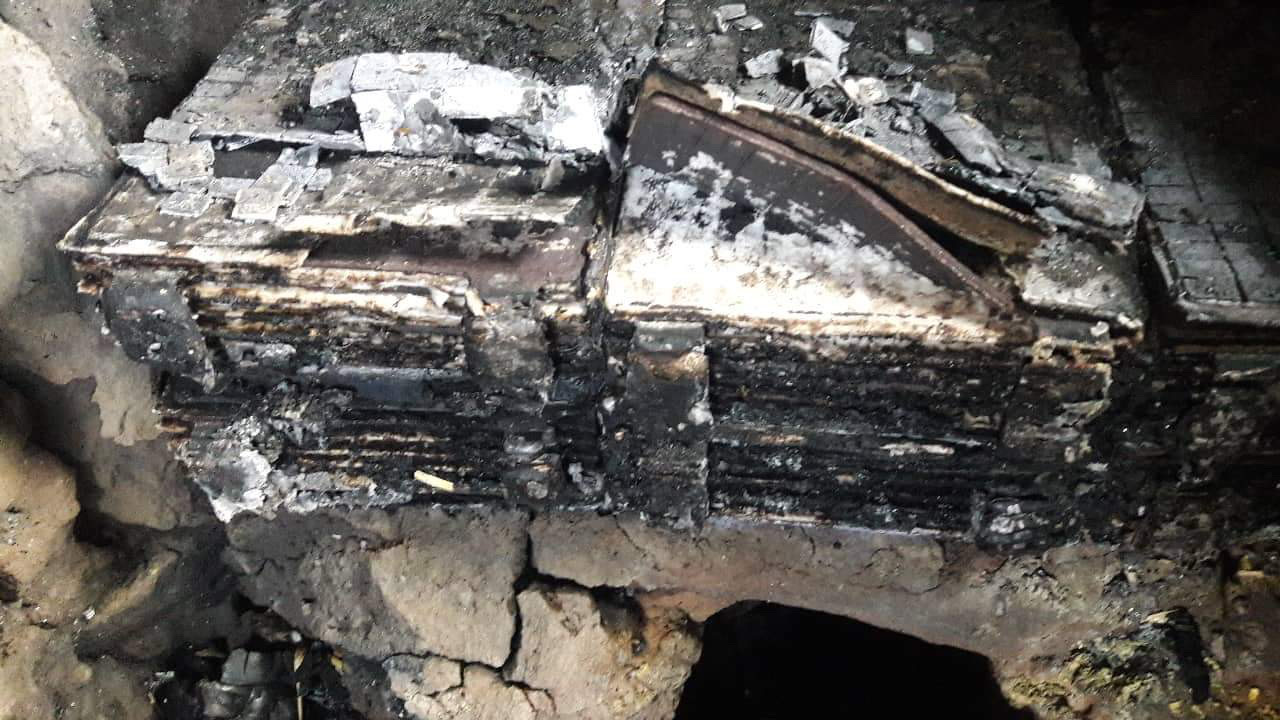
On January 18, a fire in the little kitchen in Asunta and Armando's home in Llachon, on the Capachica Peninsula, started at the 5 gallon propane tank and spread throughout the kitchen. The solar panels were mounted on the roof above the kitchen. When the fire spread to the battery, it exploded. The family had run far from the fire before the explosion, fearing that the gas bottle might blow (it didn't), and no one was hurt. Neighbors rushed to help and buckets of water saved the rest of the house.

This first picture is during the repair, as it will likely be the thumbnail for my Facebook Post, and I don't want to emphasize the battery!
So here is the battery and fire damage:
Panel fell, broke, and burned

Battery. You can see the plates.

Kitchen tools melted and destroyed
When we arrived the power was off!
The family had rigged up power from the neighbors after the fire, bringing a 220volt wire across the field so they could have lights and so Armando could play his electric piano. He is a serious composer and sometimes forgets to eat when he is deep at work. However, a lightning strike that morning had taken down the grid, which is fairly frequent in this town at the end of the power line on the Capachica Peninsula. We prepared dinner by headlamp and ate by candlelight, and decided that the solar system needed to be replaced.

Mariella Sarita, high school student who wants to be a lawyer when she grows up.
Last year the power had gone out all over Llachon and none of the students could study in the dark. Sarita was the only student who submitter her homework! Because her family had solar pwere, she had light to work by. After that incident, one other family in the village installed solar electricity!

Early the next morning, Sam and Armando and Silvano left before breakfast to go to Juliaca to buy and new panel and battery. Only it turned out that a big protest was going on in the city. 
Tires on fire and roads blocked in Juliaca
 They had to walk several more blocks than planned, and store doors were only open a crack until the marchers passed. Happily, they found willing merchants in the solar stores and found some good equipment. The charge controller was located in another room and had survived the fire. Testing it at the solar store proved its worth.
Solar store in Juliaca testing the charge controller.
Assembling the equipment
As soon as the guys got back to Llachon, we started assembling all the parts, including testing the second 100w panel that seemed to have survived the fire. After the soot was cleaned off, it was fine!
Uniting and wiring two 100w panels
 Installing the panels on the roof:
Young Jhoel keeps positive and negative wires separate
Asunta had been working on a new and colorful manta.
Of course, one of the main reasons we went to Llachon in the first place was to visit Kusi and her new 7-week old baby boy. He was slightly premature in his birth, but is progressing nicely. He was awake enough for a little baby bouncing on Tara's part.

Jhoshua with mama Kusi
 It rained all morning in Llachon while the guys were in Juliaca, but we did life--
Jhoel with the sheep
 I actually got to make a drawing from the shelter of their comfortable comedor (dining room) looking out this big picture window. My drawing was in the early misty light, but then the sun came out:
Asunta and Armando actually do have a room to rent for tourists. If you ever want to stay overnight on Capachica, it's a sweet place to stay--PLUS IT'S SOLAR POWERED!


Monday, March 23, 2015

Mountaintop and Other Scenes

Mulcina
The ceremonial site of Mulcina 
is the highest point on Taquile.
It corresponds to the Apu Karu of Lachon, Capachica Penninsula and the Patcha Tata heights of the Island of Amantani. Sam made it an almost daily practice to hike to the top, a physical and spiritual exercise.
Trail to Mulcina
approaching the walled ceremonial site
ceremonial fenced area at Mulcina
The 360 degree view from the top included the snow-capped mountains in the distance on the north and east sides of the lake, when the cloud cover lifted.

Cordierra Real in Bolivia
 The trail to Mulcina passes mossy rocks; in these are growing the delightful muña, a mint family shrub which we enjoy as an herbal tea.


 Ruins with flat large roof stone partly fallen into a shaded, mossy room.

 Another fine excursion is to the beach. The water here is somewhat shallow and protected, so swimming is cold but possible. The sand is delicious for play. Taquile has more than one beach, but this is the biggest with the best sand:
Beach view from above
One day Sam and Tara with Clever and Ivan spent an afternoon playing in the sand.
Ivan taught us to pour water into dry sand to make a temporary bowl sculpture.
 Clever and Sam engineer channels of water and sand.
Beach engineers

Thursday, February 12, 2015

Family homestay in Llachon

A Family Homestay on the Capachica Peninsula

Asunta and Armando, with their beautiful children, have created a sweet place to stay out near the point of the Capachica Peninsula of Lake Titicaca. Munay Vista Lachon

Guide service available: Armando grew up in Lachon and knows the place well. In addition, he took a Local Guide course so is well qualified to guide visitors.

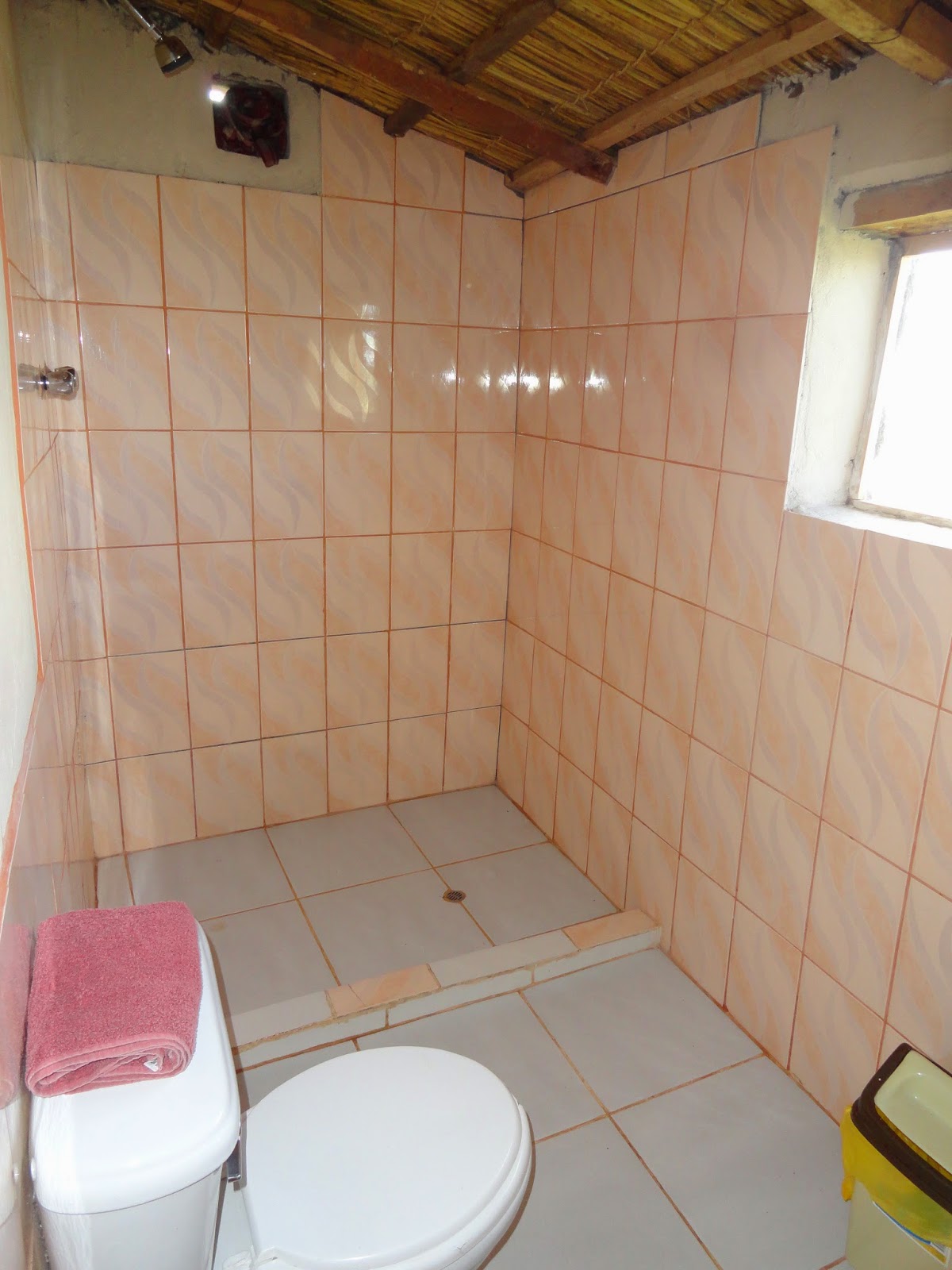
Comfortable Rooms: Two tourist rooms are available, one with a double bed plus a single bed, and the other with a double bed. Also, neighbors have rooms if your group is bigger. All have private bathrooms with flush toilets and solar hot water for showers.

Views: The dining room has a panoramic view of Lake Titicaca, with Taquile Island to the left, the totora-reed bird habitat in the middle and the lights of the city of Puno far to the right. The sandy beach is great fun for games and sand castles.

View from the dining room

Walking trails give a view of the charming center of town

Llachon view

Pre-Incan structures--and family fun!

convenient table in the room

Single and Double beds
Solar heated shower and flush toilet


Kusi, Sarita and Jhoel in the dining room

Tuesday, March 23, 2010

Community Trail Building

TRAIL BUILDING

Imagine how the Incas made their roads and buildings. What we saw was a panorama of perhaps 800 people, red sweaters and hats against the green fields and grey rock, building 600 meters (think over 6 football fields long) of improved trail about 5 feet wide. Taquile is composed of 6 suyos or neighborhoods (thus the 6 dance troups). In this massive community project, each suyo completed 100 meters of new trail. Men using wedges and big hammers pounded and split the sandstone rock into blocks; the sound is chink, chink, chink of metal on metal. They carried rocks in wheelbarrows and on their backs. Armando had a nice sheepskin to pad his back from the heavy rock. Think two feet by three and six inches thick; I can't guess the weight.


Women sorted gravel and brought it to the trail, carried bags of sand from the beach (a long climb), bags of cement from the boat (the same long climb) and smaller rocks. Very hard work. Very. Sometimes they found sit-down work.

We walked the whole length of the job, greeting and receiving greetings from people we've known for years as we went. We played with some of the children--Cusi and Sarita babysitting their little brother Johel. We carried a few rocks, our token contribution, but then joined in the rock placement work. Just like any rock walkway project (only without the truck to drop off the pallet of flagstone), we worked with Armando to help put the puzzle together of which rock fit where, and chipping or leveling the sand underneath to make a level path. In some places, culverts were made with rock passageways for water to flow underneath. In other places several levels of rock were built up to reduce the dips, level the trail.

On the boat returning to Puno yesterday, we met an engineer from Puno who had consulted on the construction of the trail.

The whole project was done in three days, the authorities walking up and down to pass out coca leaves. It's a beautiful trail, smooth enough to walk upon in the dark without a flashlight, no stairs. I personally grieved some of the beautiful living rock that was split apart to build the trail, but no one else seemed to care, and really, Taquile has a lot of rock.

Friday, February 19, 2010

How to visit Taquile Island in Lake Titicaca

Photo: Delfin on the boat dressed in traditional clothing with Taquile Island in the background.

Taquile is incredibly beautiful with terraced fields, views across the blue Titicaca lake water of the Bolivian snow-capped mountains, and skilled fiber art. Plan to stay at least one night. Plan also to buy tejidos (textiles), either from the artisan's cooperative or directly from your host or other family. This weaving is among the best in the world, very fine double warp patterns. Your purchase helps keep the technique and the villagers alive.

From the city of Puno, Peru, ignore all the tour guides (this won't be easy) and catch the turquoise topped communal boat to Taquile Island by going to the Puno Port at 7:30 in the morning. Taquile has the first office on the left as you arrive at the port. Look for the men dressed in traditional Taquile garb: black trousers, white shirt, black vest, red hat, and red or white cummerbund. It's cheaper than the guided tours and more fun because you ride with local people. Recent regulations have denied the Taquile community the control over tourism that they used to have when ALL the boats allowed to dock on the island were communal Taquile boats. The tour boats don't pay the locals anything and are rather unkind about not letting them ride on the boats.

After the 3 1/2 hour boat ride, you arrive on the East side of the island, so avoiding the famous five hundred-stair hike up to "the arch." You'll hike down those stairs for the return boat to Puno. STAY OVERNIGHT IF YOU CAN! Ask to be assigned to a host family. Rooms are basic: clean and with plenty of blankets; currently the community certifies the tourist comfort of the rooms. Bring fresh fruits and vegetables from Puno as a gift to share with your host family; you can buy lunch from them. Note, once you get up he hill you'll be at nearly 13,000 ft or over 3800 m., so be sure to take it easy and drink plenty of fluids.

Although many restaurants have opened in recent years, we recommend the communal restaurant on the east corner of the central square in the pueblo. Families rotate turns running this restaurant; menu is fish and a very flavorful soup.