Thursday, January 25, 2018

Maintaining Paradise

Quarterly Island Cleanup
Every three months, the whole community gets together to pick up litter. We have participated in past years, and here we are again. While we were walking around, we connected with a couple of tourists from Spain who were so enamored of Taquile, the man kept saying, "This is paradise; Taquile is paradise."
Each of the six sectors of the island had their own territory and everyone participated, even children:
 We brought the sacks of trash to a small dock and waited for our reward;
Add caption
 The reward was a bag of sugar! Alicia, sister to my son and comother of my blood-nephew, Nathan, was in charge of dishing out the sugar.

When we finished at the port, we hiked back up the island to Alipio's house where we refreshed ourselves with a watermelon that strong, young, Ivan had carried in Sam's backpack all day, even as he carried trash. I told about the Spaniard who kept repeating that Taquile is paradise and asked the group of Taquileños if they were cleaning up the island for their bag of sugar, or to maintain paradise.
The resounding reply was !Maintaining Paradise!

They know what they have here and it is wonderful.

On the way home, Big Samuel helped carry little Samuel who had been walking with his mother helping pick up litter all day. Two happy, if tired, Samuels:


Preparing for Solar Installation

A household of single women will receive a solar installation, thanks to the YouCaring fundraiser created by Empowered Energy Systems, Brad and Danielle Burritt (see blog post December 2018).

Our dear friend, Fredy Huatta, is now married to Rita and they have a sweet a little 2 year old. Her mother and sister live in a house with an ancient, cracked and barely functional solar panel. Rita sometimes stays here when Fredy is working with his boat and as a guide from Puno.

When we came to measure the house for wiring, and plan the installation, the women made us a fantastic meal:
Chicken Soup and Trout--with potatoes and chuno and corn
We also made a coca-leaf ceremony, offering our prayers for a successful installation, as well as blessings on the union of Rita and Fredy.

So our first trip to Puno includes buying solar panels and batteries:


2018 First week

Arrival on Taquile
We arrived in Puno on Thursday, January 11, after over 24 hours of travel, we met at the Juliaca Airport by Silvano (our son by virtue of being his padrinos de matrimonio) and Fredy, beloved young man we've known since baabyhood. A happy, happy reunion. Friday was a day of shopping for supplies and then immediately on Saturday to Taquile, where the rest of the family helped us carry all the bags and bundles up to the house where our old room and lunch were waiting.

After lunch, a volleyball game broke out. One wonderful thing that happens while we are here is that extended family and friends get together in ways they never do in ordinary daily life. Rains have been regular and everything is green and beautiful.


We slipped away from the games to visit our goddaughter, Natalia, who has recently given birth to a baby boy, Roland Bradley, here wrapped in a crocheted blanked made by my mother, Irene Miller:

Taquile citizens have learned that we bring solar gear for sale or trade, this year our goodies include charge controllers and inverters, efficient LED lights, USB ports and battery voltmeters, as well as rechargeagle headlamps and flashlights. Within a couple of days we have traded or sold a large percentage of what we brought.
controller, inverter and lights traded at Rosa's family
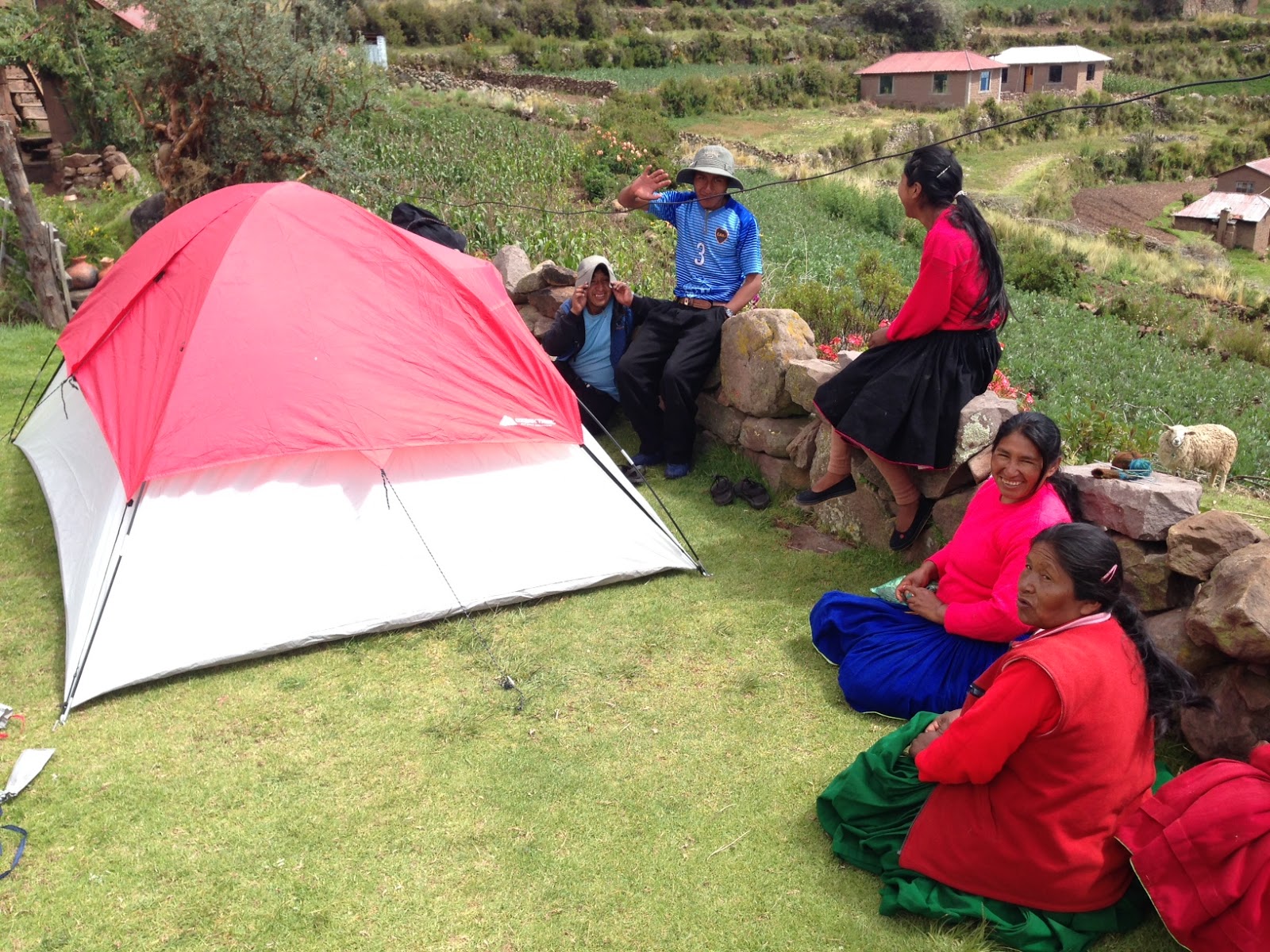
The winter season, is the time to preserve their staple, potatoes.  The technique is to freeze the potatoes at night and then, after they thaw in the day, step on them to break the membranes so the water can evaporate and dry. Thus they can be stored for years. Since global warming, they can no longer do this job on the island and the family has to take their potatoes to a higher altitude place on the mainland to make chuño, or freeze-dried potatoes. To help make this more comfortable, we brought a tent!

The various families will share the tent, and, ¡wow! were they happy!

We also brought gifts of objects and money donated by the many godparents and friends of Taquile who help us make a difference here. !THANK YOU!

It wasn´t all trades and gifts, though, Clever turned Edith's plate of egg and potatoes with tomato into a bearded face!
 And some baby chicks were hatched at Celbia's house. Lizbeth loves their soft fuzzy life:

The school system suffered a teacher's strike last year, so the school year went late. This is the first time we have been privileged to witness the closure of the school year, something like graduation in the US, with honors presented to special students. Our grandson, Ivan was president of the school last year and this photo shows him passing his regalia of office to next year's president, a girl for the first time in history. About time, I say, but Ivan says the boys aren't so sure.

Back at home, Clever and Ivan are in a fierce competition, a chess tournament:
They take time to teach young Charles how to play the game.
Everywhere we go, women are weaving, getting ready for Carnaval:
Kusi has almost completed this chuspa, or coca purse

Alicia, Celbia and Kusi get social with their weaving
And, of course, we meet up with our little kid buddies and play games.

Tuesday, December 12, 2017

Solar Classes on Taquile

Taquileño Solar Professionals -it's about time
We sometimes claim (without data) that Taquile is the most intense use of solar energy in the indigenous world, with their three community water pumping projects, some hot water systems, and almost every household with their small PV systems, adequate for lights and music.
240watts for the freezer at the tienda of Eufrasia and Delfin
Now, as Taquileños want to add more amenities to their lives, such as refrigeration or even blenders, and PV systems get bigger, it is time for a few local Maestros to be available for safer installations and troubleshooting.
We have an incredible opportunity in association with our Colorado professionals who visited last year (see their amazing story: http://taquilefriends.blogspot.com/2017/03/solar-installations-2017.html ) Brad and Danielle's son, Asa, is also a professional solar installer and speaks Spanish fluently to boot! We have launched a crowd-funding site to bring this talented young man to teach, first an advanced course for a few, and then more general maintenance classes for the general community. That site is https://www.youcaring.com/taquileisland-1030571   [UPDATE: We made our goal in 10 Days!!! Stay tuned for stories about the workshops when they happen in February.]

German already has a lot of experience
Sam and I are preparing to buy our tickets for a mid-January to early-April trip in 2018 so we will be present in advance of the Burritts' arrival to make sure all plans are in place. I will now quote, below, Brad's letter to his family, friends, and solar clients with their point of view of their experience in Peru, and excellent details about the plans for solar classes:

-------- Original Message --------
Subject: Peru solar classes


Friends and Family,

Greetings!

Danielle and I are working on a modest project to do solar electric classes on Taquile Island on Lake Titicaca in Peru, and we would appreciate your support.  Last February, we visited Taquile Island for a few days at the invitation of our friends Tara Miller and Sam Brown of Paonia, who have been visiting the island for over 30 years.  We were blown away.  The people are some of the friendliest we have ever met.  There are no roads and no dogs on the island.  The same families have owned and worked the land since before the Incas.  Everyone walks, and there aren't even many wheelbarrows, partly because the trails are so steep.  Most amazingly, there are no powerlines!  Many homes have small solar electric systems; some have none.

It's amazing how grateful folks are when they get set up with a small solar electric system.  While we were there last year for just 5 days, we helped Sam and Tara set up two different solar systems.  (Sam and Tara have been helping folks there get solar for decades, and they help the community in a myriad of other ways, too.)  One of the families we installed solar for includes a single mother, her parents and her daughter.  Sam focused on this family because it is very poor, and the school-age daughter needed light to study with at night.  (We also put LED lights in some other rooms, including the "Inca" kitchen which was tiny and dark as a cave.)  The other family we helped install solar for needs electricity because they are setting up a small hospedaje, or bed and breakfast, for income so the father can be home more since he now has to leave for weeks at a time to go away and work in others' fields.  (If a hospedaje qualifies, it gets government promotion, but it has to have a tiled kitchen, flush toilet and shower, and electricity for lights and cell phone charging for the visitors.  They had boot-strapped for years and had everything installed but the electricity!)

The work of Tara and Sam and some others have been incredibly beneficial, but we saw a big need for more focused education for the islanders on solar electric systems.  Almost all the systems are tiny or very small (20 watts to maybe 500 watts), and while the residents are of course intelligent and resourceful, they don't know much about the general theory or design principles of the systems they have or are getting.  (For instance, while I was there, I gave maybe a dozen lecture-ettes on having appropriate overcurrent protection for any circuits connected to a battery.  If you know what this is, you know how important it is; if you don't know, you are in the same boat as many of the islanders are!)  Also, the systems are gradually getting larger as prices come down.  And as system size increases, their complexity increases, and their danger, both regarding fire potential and shock hazard, increases even faster.

Our plan is to go back to Taquile Island this February and provide some classes so the islanders have a better handle on this technology.  One class will be small, for 3 to 5 locals who already have some knowledge of solar principles, installation, and troubleshooting.  (We worked with two such folks last year, and they have voracious desires to learn more.)  The second class would be bigger and would include folks who already have solar systems for are planning to get them.  Our plan is to have the participants of the first class help teach this second, more general class since they know the folks, and they will practice what they learned in their higher-level class, and finally, they would gain credibility as the knowledgeable go-to solar folks when we leave.

Sam and Tara are going back in February and will help us put the classes together and help with them on the island.  Danielle and I will do the same, on our own dime, like we did last year.  But for the classes, we hope to be able to bring our son, Asa, down to help teach the classes.  (He's very fluent in Spanish; he's taught numerous classes as a tutor and as a chemistry grad student at Cornell; and, he's super sharp with solar, having worked with us over the years, having worked as a lead installer for Namaste Solar in Denver and Boulder for a year and a half, and last year, getting his NABCEP certification in solar installation.)  We hope to raise $2500 so we can fly Asa down with us, and also take a couple of suitcases of solar charge controllers, LED lights, cell charger outlets, 230-volt inverters, and a couple more Spanish language SEI textbooks (to add to a couple we mailed down this year already!).

Will you help us??  We set up a fundraising site:
http://www.youcaring.com/taquileislandsolar
It's easy to donate there, but it costs us a bit to use them.

If you want, you can just send us a check in my or Danielle's name, and we will put it in our Taquile solar fund.  Here's our address:

Brad Burritt and Danielle Carre'
12125 Burritt Rd
Hotchkiss, CO 81419

I attached a great brochure Danielle put together for this project - check it out!

Thanks for taking a look, and for considering helping us out with this project!  Email or call with questions.

Brad

Brad Burritt
Empowered Energy Systems, LLC
12125 Burritt Rd
Hotchkiss, CO 81419
970.234.5412

NABCEP Certified PV Installer #091308-5
NABCEP Certified PV Tech. Sales #PVTS01911-3

empoweredenergysystems.com

Checks can also be sent to
Tara Miller
41342 O Road
Paonia, CO 81428


Tuesday, October 31, 2017

Holiday Shows 2017

Please join us at our holiday art shows, selling textiles that we fairly traded for solar gear with our family and community of Taquile Island, Lake Titicaca. Also a selection of pottery.
  Our home show in December:
Paonia Holiday Art Fair
Friday, December 1, 3-8pm
Saturday, December 2, 9am -5pm
Blue Sage Center for the Arts
228 Grand Avenue - Paonia, Colorado
We'll be showing TEXTILES plus our own Handmade Pottery


Did I tell you that the Taquile Island community has been deemed a 
UNESCO Cultural Heritage Site? 
~ ~ ~
November 4, 8am and 3pm
Holy Family School
786 26 1/2 Rd, 
just north of interstate 70 in Grand Junction, CO

Our booth will be located between the two buildings, outside. Weather promises to be partly cloudy and cold -- just the right weather to try on the exquisite knitted wool hats! 
We will bring a small sampling of our pottery to this show.


Sam all dressed up at the Holy Family School Holiday Show

~ ~ ~
  Our home show in December:


Monday, April 10, 2017

Fun with Food


People ask us what we eat, so . . . 

Miqui, SOUP, Quechua noun;
     Miqui, EAT, Quechua verb.  

The most fundamental food the indigenous highlands of the Andes is a juicy vegetable soup based on potatoes. Together with herbal teas,  usually made from fresh local plants, such as the perennial mint, muña, provides liquid as well as nourishment. The soups are varied, with quinoa or pearled barley or crushed corn, usually thickened with squash known as sapaillo, sometimes containing freeze-dried potatoes known as chuño. The soup is always the first course, but often a secundo follows the soup. 

Enhanced by varied sources of ingredients which come from the Amazonian jungle, the oases in the coastal desert and the high altitude plains, Peru has become known for its creative cuisine. The traditions and creativity have spread throughout the country. This year we took pictures of especially yummy foods and attractive presentations. 
Market in Lima reveals the abundance.

On special occasions, such as with well-paying tourist guests, dinner is served on the fish-shaped platters. Ruperta is an excellent cook and this trout was poached in a mixture of ginger, onion and red bell peppers. Note the plate of coca leaves for the after-dinner tea on the upper left.
potatoes, trout, with rice in a fish-shaped platter 
Ruperta was always happy when Sam bought checking to bring home. Note the muña for after-dinner herbal tea in the upper right of the photo.
Chicken stew with rice, soup
fried trout and potatoes with beets, green beans, sweet potato
City treat is to take a group out for dinner at the broasted chicken restaurant. We can host eight to 10 people for the price of the two of us at a moderate restaurant in the U.S.
Yaquelin enjoys her first restaurant meal: Pollo a la Braza


In Spain and Peru (in contrast to Mexico), a tortilla is an egg scrambled with onion and tomatoes or other vegetables:
Soup, egg tortilla, beet salad & french fries.
One day I travelled to Puno alone on the early boat and went out for a treat of a meal by myself: Ceviche served with camote sweet potatoes and toasted corn.
Ceviche in a restaurant in Puno
Celbia's sheep broke his foot, so we ate it. 
Delfin and Clever butcher the sheep.
The result was a meal of roasted mutton with camote (sweet potatoes, new potatoes and rice, with rocoto (fresh salsa) on the side.
Thanks, sheep, for giving your life for our nutrition
Sometimes food is too yummy to take the picture before it is half eaten. These baby new potatoes with a beet salad was one of these times.
 beet/carrot/onion/lime juice salad
In Lima, food is more summery, salads instead of soup.
Lentils with sea fish served with avocado salad
Stuffed Avocado--chicken salad
For really special occasions on Taquile, I mix up some banana cake and bake it in the solar cooker. This was Eufrasia's birthday, Feliz Cumpleaño! Definitely not Andean traditional, but becoming a Tara and Sam tradition.
birthday banana/chocolate cake in the solar cooker  

Sunday, March 19, 2017

Excursion: Cutimbo


Family excursion to hot springs and more ruins
Carnaval ended with a blowout on Sunday night. Fredy's boat had come with cargo and was poised to return to Puno empty on Monday, so we decided to fill it up with passengers and begin a family excursion in spite of hangovers and exhaustion after a week of parties. We especially wanted to include the family of Francisco and Juana with their daughter and granddaughter, Olga and Rosie. School will not start for a week, so this was our last chance to include the kids.

First thing in the morning, we hiked up to Olga's family to talk them into coming.
Tara, Rossi, Juana and Francisco in their kitchen
 Olga's brother had sprained his ankle during Carnaval, and needed to return to Tacna for his work, so the offer of a free boat ride convinced them to come. Olga deferred, but we filled the boat and started the journey:
Rossi with Tara, Amantani and Taquile in the background
Sam with Lisbet
Kusi and Edith, girlfriend cousins on the boat
Esteban's son-in-law, Demian, lives in Puno and runs a bakery with a brick bread oven plus owns cars to distribute the bread. One of his vehicles is a big van (combi) that legally carries 15 passengers. We hired the combi, filled it with 18 passengers, including Demian's extended family and went first to the Loripongo hot springs about a hour drive from Puno. Simple place, where they empty and clean the tubs after each use and fill them with fresh and very hot water. It doesn't take too long to cool down enough for a luxurious healing soak.

Ruperta and Eufrasia got up early to roast chicken with sweet potatoes and potatoes in the bread oven to add to our lunch.  Good thing, because Sam and I only brought boiled eggs, cheese and bread for 12 people. Turned out we had a feast of a lunch after the hot springs.
Our driver waves; Eufrasia dishes out the chicken
Rossi and Juana enjoy their meal


Cutimbo
Driving back toward Puno, we stopped at Cutimbo, Inca and Pre-Inca ruins about a 1/2 hour drive from Puno, but with no regular transportation, thus seldom visited. Rain had started, so part of our group waited in the bus while the rest of us wrapped ourselves in plastic and hiked to the top.
 With both round and square chulpas, this archeological site is of high quality rockwork, comparable to Sillustani and the Sacred Valley.
 The perfectly-fitted rounded rocks contain low-relief carvings of puma, monkeys:
bas-relief carvings on the rocks
puma
We took shelter in front of this restored cave, buriel place with pictographs (behind a proctective fence and with a full time guard), to do our coca leaf ceremony. The guard (watchiman) did not join our ceremony but was extremely friendly and forthcoming with information. He said this was Pre-Inca, about 1100 a.d. and that there are many more such sites. This one has been fence-protected for 17 years and is reconstructed as far as the bones and pottery placement.

note pottery (far left) and bones

see the stick llamas?
Even in the rain, the site is beautiful, rich with vegetation, including this native tree that reminds me of manzanita.
native tree

We finish the day with everybody's favorite: pollo a la braza.

Most of the family stayed on the mainland and helped Esteban work in his potato field between Puno and Juliaca. We stayed to write the previous blog and print pictures of the excursion to give away. We all rode the boat back to Taquile together on Wednesday.