Showing posts with label Indigenous Dance. Show all posts

Thursday, March 1, 2018

Taquile Carnaval 2018

Carnaval is Color and Movement and Sound.
After a day of rest and recuperation from their flight, plus enjoyment of the Puno Candalaria Festival, the Burritt/Carre family joined us on Taquile Island, where Carnaval is already in progress. We came on the boat on Tuesday, just enough time to prepare for the biggest party day, Wednesday, Feb. 14. In contrast to other Mardi Gras celebrations in the world, Ash Wednesday is the BIGGEST party day of the week. We had a delightful guest, Catarina from Italy, who joined us in dressing up and dancing.
Here Ruperta is helping Asa dress in the complicated clothing.

Women wear multiple skirts, red mantas (large carrying shawls), intricately woven cummerbunds (called a chumpi) with their black head covering (called a chucko) and carrying weechee-weechees, yarn  pufts to twirl in their hands. The men also have red mantas, often with a larger central pattern than the women's, also have the cummerbund chumpis, but wear a full-sleeved colonial-style shirt, black short vest, often have red banderas across their chests, and carry longer weechee-weechees than the women. They also wear multiple coca-purses (chuspas), sometimes as many of 15, carefully set to the same length so the fringe resembles a skirt.
Notice the grasshopper; I've never seen a grasshopper on Taquile.
I wore 5 skirts on Wednesday and found that their weight with dance's hip movements introduced new muscles in my body. I switched to 4 skirts for the rest of the week.
 Each of the 9 dance groups gather in the Plaza after lunch, dressed in their finest, and compete one-group-by-one in front of the autoridades. They also play music and dance in cacaphony, various groups playing at the same time in glorious confusion.

The festival is a progressive party, dancing in procession from one house to another. The leaders of the various groups are officers in the community, invited to various houses by relatives or friends. This culture is very strong on recipocity, so invitations flourish depending on relationship. We danced with two different groups, that of Dario from nearly the far west end of the island, and with Nestor's group. We had plenty of family and friends in both groups and hosted each in our home, one on Thursday and the other on Friday. We bought lake trout to serve our guests.

How it all works: The procession is lead by the youngest and most energetic women, sipas munay, in the brightest skirts. Dario's group had a very large group of these beautiful young women and I joined them most of the time, whooping with the drums and flutes of the men, who follow behind the leader. Trailing the main group are grandmothers and young mothers carrying their babies. The last of the procession is the matriarch, the wife of the group's leader, who gathers up the stragglers and drunks to get to the next location.

When we get to the house, the men leaders sit on a bench and the women sit on sheepskins on the ground opposite them.
Food is served on a beautiful handwoven cloth, an uncuña, usually steamed new potatoes and reconstituted freeze-dried potatoes called chuño, and sometimes corn or fava beans. If fish are included, it is always a treat--and it goes fast. Always a spicy sauce is included, either an onion/tomato/roccotto pepper/lemon mix, or as in the following picture, cooked onions with yellow peppers called aji. Everyone comes forward to pick up handsfull of food.
After the main dish, watermelon is served. One for the women, one for the men, and another for the band. OOPS, NO WATERMELON PICTURE--TO BE ADDED, STAY TUNED.
We dance for awhile in the house; here two little boys manage the drums. 
Beautiful child enjoys the party, too, especially the watermelon.
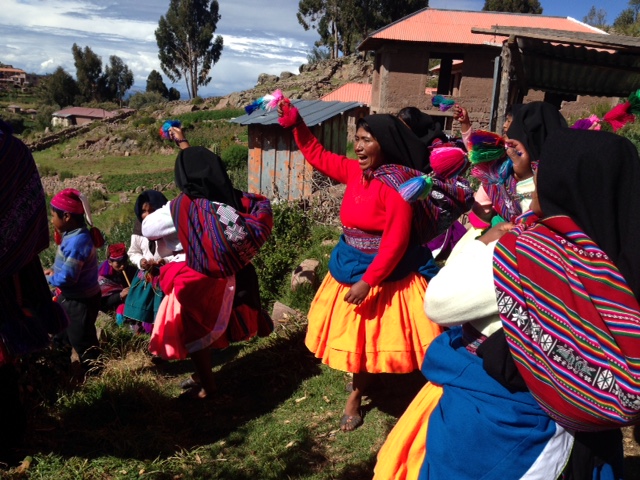
Waving the weechee-weechee as we exit the house
 With the watermelon comes the beer, shared all around, and then coca is offered and off we dance to the next house.
Cantuta, Taquile's official flower, blesses the foreground of the procession.

Here the procession climbs down the steep stairs toward the Chilcano port--only 2/3 of the famous 500 steps--to Zenon's house.
When we dancers, ahead of the musicians, arrive at a grassy field, we enjoy jumping out onto the soft grass and dancing in a circle until the musicians and the rest of the procession catches up.
Dancing through one of Taquile's stone arches.
Note how the multiiple fringed chuspas resemble a skirt. This man jumped up on the side of the arch, waving his weechee-weechee, cheering the dancers and musicians on to the next house.

Alicia is so beautiful with her bright smile, colorful clothing and happy dancing.
Carnaval started on Monday with six autoridades leading the six groups. Then on Wednesday, the three top officers, the Mayor and two more, started their groups. All danced for the rest of the week, the top officers ending on Saturday evening. 
Sunday evening around 4:30 the remaining groups again head for the plaza. Only this time the young women remove their outer skirts so only the bright (almost day-glo) yellows and greens are all the way round. The men also shed most of their layers. The resulting pairs swing hands in an almost running dance through and around the plaza. Again cacaphony reigns as multiple groups play and dance at once. Fireworks light the air; beer is shared all around. Energy is HIGH!

At last the groups dance off to the house of the authoridad leader, where soup is served and then more beer and then more coca. Sam and I escorted Dario to his house (he was a little drunk); Sam holding Dario's arm and me managing the flashlight. Turns out he lives a mile or two west of the plaza. Once we got there, we were served first, a soup with a nice piece of fish, and welcomed to sit with Dario's godparents who were now in charge. The young people put on the boom box with Cumbia and Reggeton and other all kinds of music. The patio filled with fun dancers. Sam and I showed off our swing dance. Brad and I as well. Asa stayed inside with the beer drinkers and got a new Quechua nickname. The evening was clear skies with bright southern hemisphere stars. We stayed until the planets rose and spent all of Monday resting. Well deserved rest.


Candalaria in Puno, 2018

PunoCapital Folklórica del Perú

The cross-quarter days between the December solstice and the March equinox, in English called Candlemas, groundhog day, or Imbolc, here in Puno is celebrated as Candalaria, a two week festival to honor the Virgin Mary and the folklore of Peru. The statue of the Virgin is carried in procession through the streets. Some claim this is the second largest festival (after Rio de Janerio) in all of South America.

One weekend features more indigenous dances and the second, called Trajes de Luces, features fantastic complicated costumes. For a group of dancers and musicians to participate in the competition, they must have a minimum of 100 members. After competing in the stadium, the dancers pour out into the streets with music and color and overwhelming energy.
Dressed for performance, the dancers welcome photos!

This fellow shows us his mask costume as he prepares to enter the stadium.

Out on the street! Sikuris with panpipes and feathered headdresses.

Twirlling the fringe

Twirling the skirts

Children join the fun and add a large measure of charm.

Skimpy costumes and high heels.

Detailed embroidered applique enhance the costumes.

Three Taquile men, including Evaristo and Elias, were in a band with their tubas.

When the Virgin in paraded through the streets, people shower her with flowers. Flower salespeople fill the streets with their beautiful wares.

 Puno is FULL of people during these weeks. Domestic (Peruvian) tourists dominate, but people come from all over te world. Hotels triple their charges and are full anyway; restaurants are jammed. Vendors and performers come from all over the country.
This gold-painted and costumed woman pretended to be a statue until someome put money in her jar, then performed a little ritual feather dance. Sam was enchanted, and frequently awoke her from her statue-hood with his coins. Then she invited him into the picture.

Wednesday, March 8, 2017

Carnaval 2017

A full week of celebration
Carnaval is Mardi Gras. Taquileños who are working in Tacna, or Lima, or anywhere in between, come home to dance, to be with their families, to support family members who are leaders of the groups. Nine different group leaders are authorities of the celebration, leading dancers and musicians from house to house.
Silvano, Sam, Tara
 Unlike New Orleans, Rio de Janeiro, and other Mardi Gras celebrations, Ash Wednesday is our BIGGEST party day, with all nine groups gathered in the central plaza in a grand dance competition, cacaphony of several bands playing different sections of the rhythm all at the same time.
Colorful, with paper streamers, all set for the big day on Wednesday.

Sam and Tara in the Plaza on (Ash) Wednesday

Twirling yarn "wiichi-wiichis" as we dance

Three (or four?) groups converge

Sam is invited to sit next to the group leader, an honor
 Sometimes it is a rock climb, in all our skirts and regalia, to dance to the next house:
large group, rock climbing
It all ends on Sunday night. This photo is too late in the day, but does show the change of clothes. The younger people shed layers, including to nearly day-glow skirts and run a VERY energetic dance all around the plaza until they go off to group or private disco-ish parties that go on most of the night.


Sunday, February 28, 2016

Arrival and Carnaval on Taquile 2016

Jumping Right In


After an overnight airline flight from Grand Junction, Colorado that started on Februry 4, a visit and lunch and nap with our goddaughter´s family in Lima, then an overnight and all day (!) bus ride to Puno, then a noisy hotel (after all, Candalaria in Puno is the second biggest festival in all of South America after Rio´s Mardi Gras), and a bit of early Sunday morning market day--we climbed onto Fredy´s new boat happily on our way to Taquile Island, Lake Titicaca. 

The new seats on Fredy´s boat. Thanks to those who pitched in!
Carnaval started the next day, Monday, February 8, with a group of dancers starting out from our neighbor´s house. We skipped day one, resting and settling in, getting our Carnaval outfits ready, hugging everyone and remembering why we are so much in love with this extended family and community. Also talking about pending solar and LED light trades.

But we jumped in full force on Tuesday and danced for the next 6 days, progressing from house to house in swirling procession. The youngest and most animated girls and women lead the way in swishing skirts and swirling yarn pom-poms, wichi-wichis, the men are next with flutes and drums, followed by everyone else. Sometimes Tara is in front with the lively ones, and sometimes trails with the grandmas and baby-carrying mothers (and sometimes the drunks) at the end of the parade.
detail of phenomenal complex weaving on a man´s poncho
The autoridad, the officer in charge of the group, lead the men, and his wife brought up the rear as the sweep, making sure no one was left behind. When we arrive at the next house, the cooks bring out a big pile of hot finger food: steamed potatoes and chuño (Peruvian freeze-dried potatoes), cooked corn kernals and fava beans, and maybe some fish--all served on a beautiful cloth on the ground in a place of honor. Each household has its own special hot sauce served frin a bowl in the middle of the pile. All the guests come forward to get their food. Carnaval came early this year, so I´m lucky to get there in time for the few new potatoes fresh from the field. Next the watermelon is served, and the beer. We have to eat and drink it up quickly to get on to the next house. The more popular leaders have many invitations. 
Tara and Sam on Wednesday of Carnaval

Wednesday is the first REALLY BIG DAY when women wear the most skirts and the men wear multiple coca purses (chuspas) and EVERYONE wears beautiful red handwoven mantas. Tara wore 7 skirts, rather heavy and very full which give some real inertia to a spin. Sam work 18 chuspas

Thursday, Friday and Saturday kept the colorful costumes and the processions going. We danced most of the time with autoridad Tomas Mamani and his wife, Yolanda, who are our co-parents, sharing the godparent duties for Dina,s little girl, Chasca/Yanet. As it turned out this group had quite a following with lots of young animated girls leading the way in their bright yellow and green skirts. One day we couldn,t find the group and travelled for a couple of houses with another leader. Suddenly, a woman asked us if we´d like to go to Tomas´s group and she knew were they are. Sure, we said. Then it turned out that her husband was too drunk to carry his big base drum and she needed us to carry it up the hill!

I learned that this festival has greater significance than merely a party: When the 4 sizes of quena flutes are playing correctly together, and the bass drum is played with power and precision, this week will bring the needed rains for the rest of the rainy season. It seems to have worked.

Sunday´s day-glo skirts
  Sunday is the final day. Around 4pm at the last house of the afternoon, suddenly the girls are switching their skirts around so only the brightest yellows and pale greens show, and the young men are removing the outer layers of black jackets, red mantas and sashes revealing their white shirts and white and black vests, Lighter, whiter, brighter. We dance to the main square as dusk sets in; the young dancers in their new costumes making new steps, weaving in and out of each other´s lines, dancing around the strong center of men with flutes and drums. Beer is served, More dancing. Fireworks!

Around 9:00pm each of the 7 groups dances into the night, back to the home house of the Leader where they started on Monday morning. Speaches of gratitude for our participation, hot soup, more beer, and--in our case, at least--reggaeton and cumbia amplified in the courtyard. Tomas and Yolanda changed their clothes and dropped their role as Leaders as mere hosts at their own home.

This festival is by Taquileños for Taquileños. They welcome visitors, but most tourists only stay for the afternoon. Lucky ones this week saw beautiful swirling skirts and listened to enthusiastic music before they caught the 2pm boat.. I saw only 7 who participated: a trio from the Sacred Valley who had been in Puno for Candelaria,and  two Spanish travellers who couldn´t leave after they saw the Sunday night excitement, followed the party to the final house of Tomas and stayed at our house,
Chiara & Johanna
The best were two university students who also stayed at our house. Chiara is from Lima and Johanna is from Spain, here to work on her thesis about indigenous musical traditions. We introduced them to as many experts as we could name, and they found their own. They did not dress up in the many layered skirts, but followed the dancers and enjoyed theirselves even with the overt attention of varyingly drunk Taquile men who wanted to marry them (!). We studied stars on Chiara´s mobile star gazing app, talked politics, and made a friendship which, I believe, will last.

Friday, February 27, 2015

Carnaval Taquile 2015

Carnaval on Taquile is a week-long Celebration

Silvano cheers us on
It's Marti Gras, but doesn't end on Tuesday night, as in New Orleans. Rather, Ash Wednesday is the BIGGEST party day. This year nine leaders who hold various community offices lead each of nine groups in a progressive dancing party from house to house. This was our fourth Taquile Carnaval over the 29 years that we have been visiting Taquile Island.

We started on Monday. Our co-father and co-mother, Gonzalo and Pelajia, are padrinos to one of the leaders, Moises. The Yucras are a large family, so Moises was invited by LOTS of households to party at their houses, so we progressed through eleven houses on Monday. Too many. Later in the week we danced with Ruperta's father, Florentino, and his group only went to 5 houses. This gave us more time to dance at each house, and to drink our beer more slowly.

This is how it goes:
The first house of the morning usually has soup; after Monday's beginning, this was also the "overnight" house, the last night of the previous evening, set up with rooms for people to sleep if they want. We don't always make it for soup, since we have come home to sleep and have our own breakfast. A desultory beginning includes bursts of drums and flutes as the host group waits for more participants to arrive; waits for the morning rain to stop.
After food, then WATERMELON. Prayer over the watermelon and three watermelon are cut: one by the men, one the women and one the band. Nice and juicy. Then more BEER, then the band starts and women start dancing. Three coca estallias are opened and blessed and hands full of leaves passed out to all the adults. Closing the estallias is the signal to get ready to dance on to the next house.

Coca estallias, nearly empty
Women in twirling skirts lead the procession
The progessive music is repetitive, a strong base drum with accompanying snare drums and harmonic flutes (q'enas). It consists of four phrases, 8 counts each, and on the fourth the dancers twirl. The procession is lead by the women with their colorful many layers of skirts, intricately patterned red chumpi (cummerbund) and manta (shawl), and activily twirling yarn wiichi whiichies. The men follow, ususally with the group leader close behind the women. They wear chumpis as well, plus a black short jacket, red bands across their chests, and some have red ponchos, also intricately woven. All of them have multiple chuspas (coca purses), some as many as 12 or 15 chuspas, all intricately woven patterns, red, and with lots of colorful fringe. The chuspas circle their hips like a skirt and fly out when they twirl (see Silvano in the photo, top of this entry). Most of the men also have wiichi whiichies, longer and with heavier balls than the women's yarn puffs.
intricate weaving

Sam gets a shade hat
in procession through an arch
This dance went briefly through a steep eucalyptus forest
When we arrive at the next house, I seek out the hostess and give her coca leaves. She is busy rushing around getting blankets down on the bench for the authority men to sit on, blankets in front of that bench on the ground for the authority women to sit on, another blanket between them for the food, and finally the food: fiabre, picnic food. Usually a huge pile of cooked dried corn and fava beans, peeled boiled potatoes, sometimes mixed with tiny fish called ispi, or sometimes trout. Always a bowl of hot sauce. Each house has its own salsa, generaly fresh chopped onions, tomatoes and rocoto chilies with lime. Sometimes avocado or tuna fish. One house had a cooked onion dip that was delicious. I carry a little plastic bag to use as a plate, so I can grab my food and sit quietly. After a while, no one is eating any more and women gather up the left overs to take home, either in a plastic bad or their tightly woven wool uncuñas, food carrying cloths.
Young Clever plays the big base drum
Wednesday was the big day in the Plaza, with competition among the nine groups.
Biggest celebration is Wednesday in the plaza

Goddaughter, Natalia, with Sam

Sam and Felipe

beautiful Cecilia with Sam
Tara and Sam
More dancing from house to house. We hosted groups at Eufrasia's house on both Thursday and Friday, with lots of advance cooking and beer buying.
Sam plays ball with the kids while grownups drink beer

Sunday night was one more big extravaganza blow-out in the Plaza. Several groups changed clothes so all the women were twirling in day-glow yellow skirts. Some groups of men wore all white. It was sunset, so the glow was powerful. Fireworks as well.
I have videos from Sunday night--and from the processions as well, but didn't manage to download them--stay tuned!